Analyzing Brent Crude’s Sharp Decline: A Structural Reversal or a Speculative Bull Trap?Summary: Brent crude experienced a significant gap lower to $85.50 following a weekend of relative calm between the US and Iran. However, current shipping data from the Strait of Hormuz and Bab el-Mandeb indicates that physical supply disruptions persist, suggesting this selloff may be a bull trap rather than a definitive trend reversal.
Market Context
Brent crude opened the week with a substantial downside gap, dropping to $85.50 from Friday’s close of $98.69. This sudden move was triggered by a lull in military activity between the United States and Iran over the weekend, prompting traders to unwind the geopolitical risk premium that had pushed prices above $100 last week. Despite this price action, the decline appears to be driven by shifting market sentiment rather than improving fundamental supply conditions, as evidenced by the lack of recovery in physical oil flows.
The geopolitical landscape remains unstable. While US airstrikes paused over the weekend, no formal ceasefire or binding de-escalation agreement has been established. While US officials indicated the pause was intended to facilitate diplomacy, the current situation is a fragile, conditional truce, with Iran maintaining a stance of reciprocal response rather than a commitment to permanent negotiation.
Analysis of Maritime Shipping Data
There is a notable divergence between market optimism and actual physical supply conditions. Shipping data highlights significant ongoing disruptions:
- Strait of Hormuz: Daily vessel traffic has plummeted to fewer than 10 commodity vessels, a stark contrast to the pre-conflict average of over 100 daily crossings.
- Bab el-Mandeb: Traffic dropped to just eleven vessels on Sunday following Houthi attacks on Saudi Aramco’s onshore facilities in Jizan and Yanbu, marking a dangerous escalation in the region.
This data suggests that while one critical chokepoint remains severely restricted, another is experiencing further deterioration, indicating that instability is spreading from maritime routes to onshore infrastructure.
Bull Trap vs. Genuine Reversal
This disconnect raises the possibility that Monday’s decline is a bull trap designed to flush out speculative long positions. While financial markets can react to geopolitical news within hours, restoring global shipping stability takes much longer. Unless vessel traffic through the Strait of Hormuz recovers significantly and Red Sea tensions subside, physical supply constraints will continue to support higher price floors. A rapid rebound above $90 would suggest that the recent gap was merely a liquidity washout rather than a shift in the underlying market fundamentals.
Technical Analysis of Brent Crude
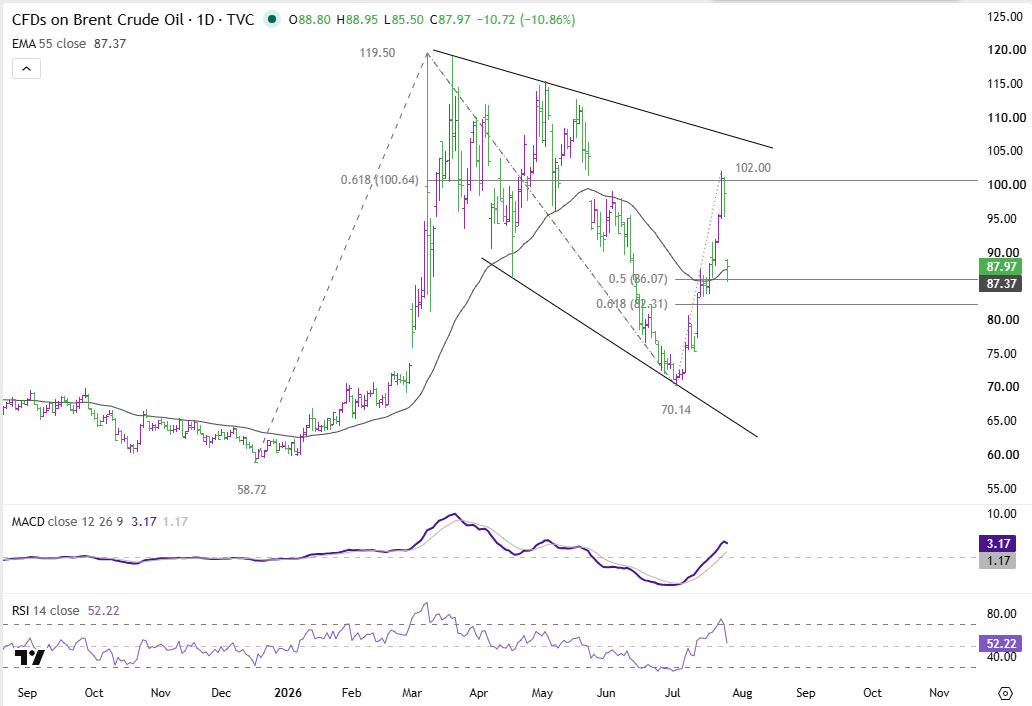
Technically, Brent encountered strong resistance at the 61.8% retracement level (100.64), leading to the pullback from last week’s highs. However, the overarching bullish trend remains intact. The recent move up from 70.14 is viewed as the primary impulsive wave of a long-term uptrend, with the current decline fitting into a fourth-wave corrective phase between 83.71 and 87.55. Selling pressure recently stalled near the 50% retracement level of 86.07, with the 55-day EMA at 87.37 providing crucial support.
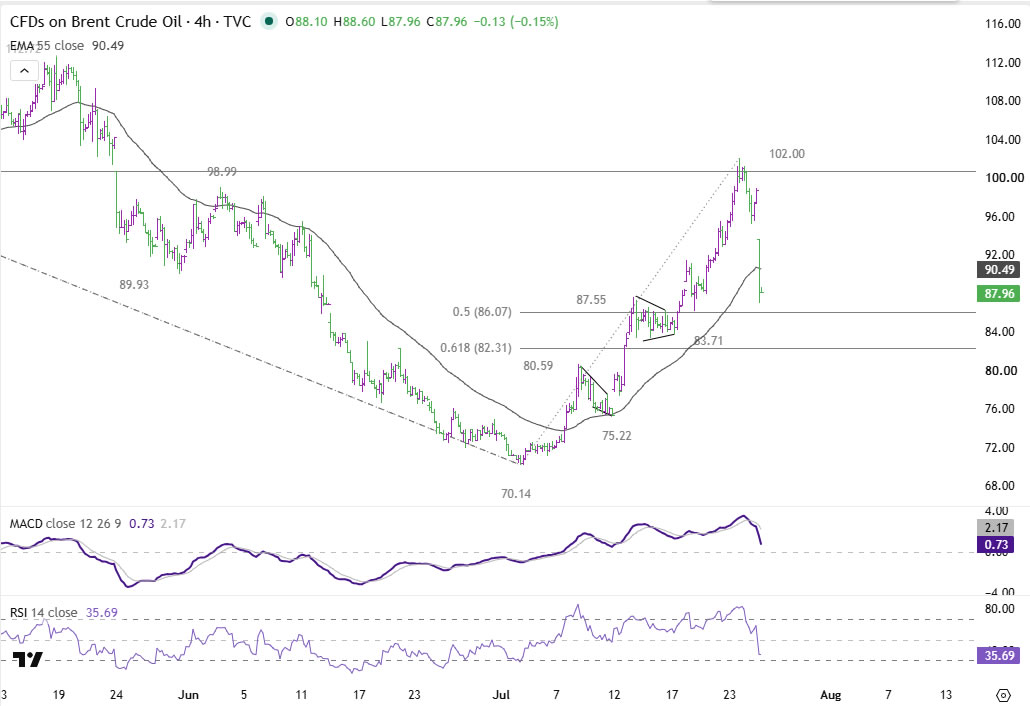

While consolidation below 102.00 is expected, the near-term bias remains upward if supply conditions do not improve. A swift recovery above $90 would confirm the “bull trap” theory, indicating the selloff was a positioning washout. Conversely, a sustained break below 86.07 and the 55-day EMA would invalidate the current bullish structure and open the door for a retest of the 70.14 lows.