







Australian and Canadian Dollars Lead as Global Risk Signals Diverge
Monday’s key themes:
- Australian dollar leads: AUD is the strongest major after China’s Q3 GDP came in at 4.5%, while RBA Assistant Governor Christopher Kent challenged the view that the tightening cycle has ended.
- Canadian dollar holds firm: CAD has retained much of its strength despite softer core inflation, supported by elevated crude prices, with Brent near $108.
- France weighs on Europe: The French 10-year yield is near 4.88% and moving toward 5% after weekend unrest, while the DAX, CAC 40 and FTSE 100 are each down more than 1.2%.
The Australian and Canadian dollars are leading major currencies on Monday, but their gains do not indicate a broad risk-on rally. The Australian dollar is supported by firmer Chinese data and reduced conviction that the RBA’s tightening cycle is over. Meanwhile, the Canadian dollar has remained resilient despite softer underlying inflation and continued support from elevated oil prices. Falling European equities and French government bond yields near 5% underscore the uneven market backdrop.
These moves are being driven by targeted economic and policy catalysts rather than a generalized improvement in global risk appetite.
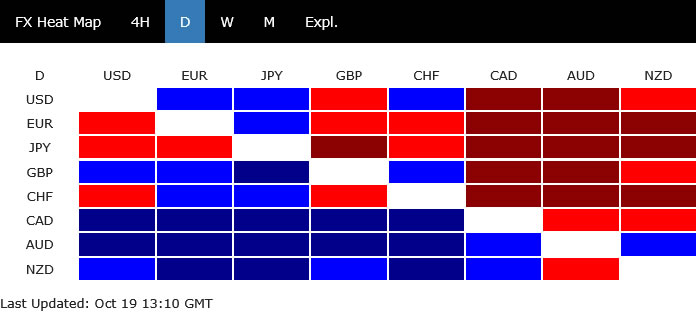

Currency heat map: The divergence is evident across asset classes. AUD, CAD and NZD occupy the stronger end of the currency rankings, while the yen and Swiss franc lag and the dollar sits closer to the middle. Germany’s DAX is down 1.29%, France’s CAC 40 has lost 1.44%, and Britain’s FTSE 100 is lower by 1.21%. Oil is retreating, while metals are mixed. Currency strength is being driven by selective catalysts rather than a generalized improvement in global risk appetite.
European Equity Moves
- Germany’s DAX: down 1.29%
- France’s CAC 40: down 1.44%
- Britain’s FTSE 100: down 1.21%
Australian Dollar Extends Gains on China Growth and RBA Expectations
The Australian dollar is the day’s strongest major currency, outperforming the dollar, euro, Canadian dollar, New Zealand dollar and yen. Its gains across several currencies suggest that Australia-specific developments, reinforced by China’s economic data, are providing more support than the broader currency environment.
China Data: Actual vs. Expectations
| Measure | Previous | Forecast | Actual |
|---|---|---|---|
| Q3 GDP, year on year | 4.3% | 4.4% | 4.5% |
| September retail sales, year on year | 0.4% | 0.5% | 1.1% |
| Industrial production, year on year | 5.2% | 5.4% | 5.5% |
The figures point to firmer economic momentum, although persistent weakness in property and fixed-asset investment continues to limit the breadth of China’s recovery.
Meanwhile, RBA Assistant Governor Christopher Kent’s comments challenged the assumption that Australia’s tightening cycle has necessarily ended. Kent noted that estimates of the neutral interest rate are rising in Australia and globally, potentially making the current 4.60% cash rate less restrictive than previously assumed. He described policy as “somewhat restrictive” while questioning whether the current degree of restraint is sufficient.
However, Kent also acknowledged that Australia’s labor market is loosening faster than the RBA expected. Employment fell by 39.3K in September, while unemployment reached a five-year high of 4.7%. The deterioration has reduced expectations of an immediate rate increase, but Kent’s assessment suggests that further tightening cannot yet be ruled out.
Kent’s Two Signals for the RBA
| Signal | What Kent said | Implication |
|---|---|---|
| Supports further tightening | Neutral interest rates are rising in Australia and globally, and policy remains “somewhat restrictive” | The 4.60% cash rate may be less restrictive than previously assumed |
| Argues for caution | The labor market is loosening faster than expected, with employment down 39.3K in September and unemployment at a five-year high of 4.7% | Expectations of another immediate increase have been reduced |
Markets currently assign roughly a 25–30% probability to another hike in November. A further increase is not the base case, but the possibility remains meaningful, particularly if inflation proves more persistent than expected. Australia’s quarterly CPI report on October 28 will be an important test ahead of the November 2–3 RBA meeting.
Canadian Dollar Holds Firm Despite Softer Core Inflation
The Canadian dollar is also outperforming, although its immediate inflation catalyst was less supportive. Canada’s September headline CPI accelerated from 3.0% to 3.1% year on year, below the 3.2% forecast. More notably, all three Bank of Canada core measures eased. CPI-trim declined from 1.9% to 1.8%, CPI-median fell from 2.0% to 1.9%, and CPI-common eased from 2.6% to 2.4%, with each measure below consensus.
Energy largely explained the contrast between headline and underlying inflation. Gasoline inflation accelerated from 22.8% to 27.8%, pushing overall energy inflation from 15.4% to 19.0%. However, CPI excluding gasoline slowed from 2.4% to 2.2%, reinforcing the broader moderation in underlying price pressures despite the higher headline reading.
CAD initially weakened after the data release, but the reaction remained relatively contained. USD/CAD rose from around 1.4077 before the release to 1.4105 afterward, while the dollar index also strengthened modestly. Canadian bond yields did not decline in tandem, suggesting that the inflation surprise did not trigger an immediate, broad reassessment of domestic interest-rate expectations.
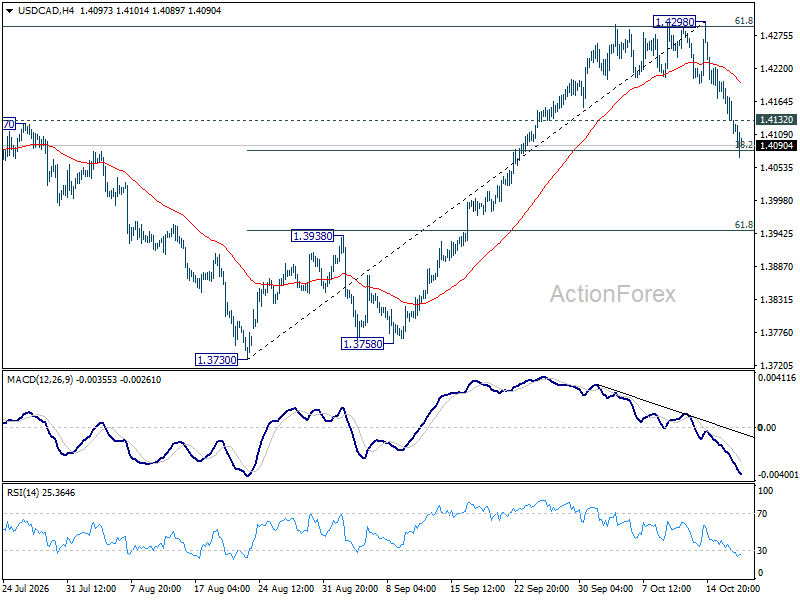
Technically, USD/CAD is testing the 38.2% retracement of its rise from 1.3730 to 1.4298, at 1.4081. The pair has found support around this area, although that support has not yet translated into a convincing bullish reversal in USD/CAD.

The loonie continues to benefit from the support provided by elevated crude oil prices. Although Brent is lower on Monday, its substantial advance over recent weeks remains relevant for Canada’s energy-exporting economy. With the Bank of Canada widely expected to hold rates at its October 28 meeting, the key question is whether softer underlying inflation will begin to weigh more heavily on CAD or whether commodity support will keep the currency resilient.
Oil Retreats Without Reversing Its Broader Advance
Crude oil prices are softer on Monday, but the pullback has not erased last week’s substantial rally.
Oil Snapshot
- Brent: around $108 a barrel, down approximately 1.55%
- Brent on Friday: gained 3.7% to $109.86
- WTI: closed above $100 on Friday for the first time since September
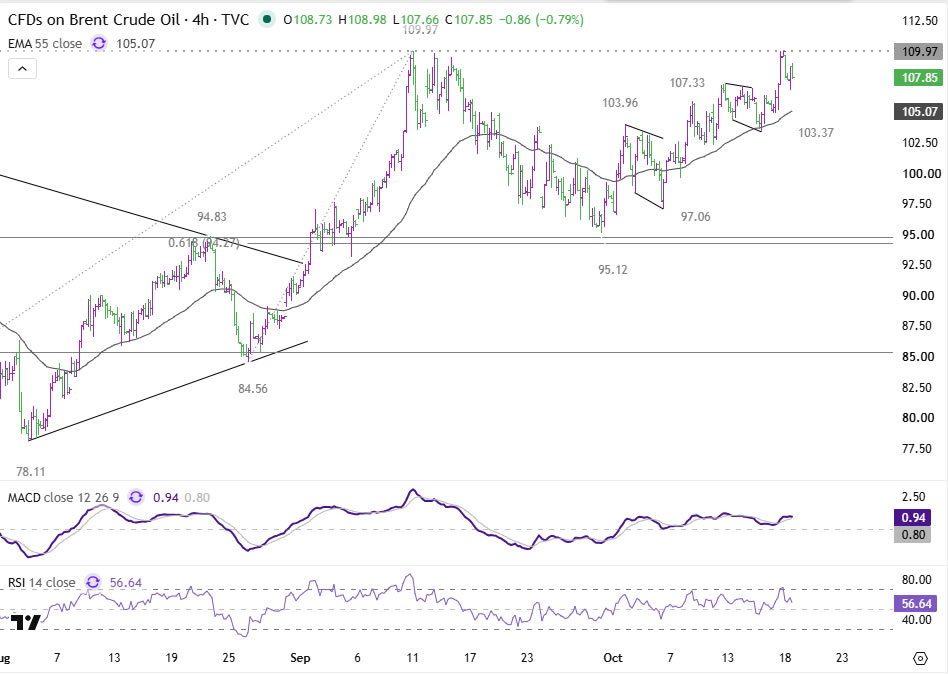

The renewed rise in prices reflected concern about global supply disruptions. Middle East tensions continue to support a significant geopolitical risk premium. Attacks on shipping near the Strait of Hormuz, threats to Saudi energy infrastructure and renewed Ukrainian strikes against Russian oil facilities have raised concerns about supply availability.
Monday’s pullback reflects competing expectations that additional Russian crude could enter the market following changes to US sanctions and tariff measures. The oil market is therefore balancing persistent supply-disruption risks against the possibility of improved availability, rather than producing a clear directional signal.
The distinction matters for CAD. Elevated crude prices continue to provide a supportive backdrop, but further oil weakness could gradually reduce that advantage. The loonie’s resilience despite softer Canadian CPI is notable, although sustained strength will require support beyond the previous week’s energy rally.
French Bond Yields Approach 5% as Political Risks Pressure the Euro
The European picture is more cautious. The euro is under moderate pressure, with EUR/USD trading around 1.1212, down approximately 0.24%. Weekend unrest has added another layer of uncertainty to an already difficult political and fiscal situation as the government confronts important budget decisions.
Saturday’s nationwide demonstrations over living costs and school conditions descended into violence in several major cities, resulting in more than 2,000 arrests and extensive property damage. President Emmanuel Macron responded by calling for consultations with students, teachers, unions and businesses, alongside tougher measures against disorder.
The unrest matters to financial markets less because of its immediate economic cost than because of its implications for fiscal consolidation. The minority government is already struggling to balance spending demands with plans to reduce the deficit. Additional political pressure could complicate the budget process and reinforce France’s existing sovereign risk premium.
French Bond Market Snapshot
- France 10-year yield: around 4.88%, pressing the upper boundary of its recent consolidation range
- OAT–Bund spread: around 145 basis points
- EUR/USD: around 1.1212, down approximately 0.24%
- France Aa3 rating: currently carrying a negative outlook
France’s 10-year government bond yield is approaching the important 5% threshold, trading around 4.88% near the upper boundary of its recent consolidation range. The yield remains well above its 55-day exponential moving average, reflecting the substantial deterioration in French debt-market sentiment since the summer.
The OAT–Bund spread is around 145 basis points, indicating that investors continue to demand substantial compensation for holding French debt relative to German government bonds. A sustained widening in that spread, however, would provide stronger evidence of renewed France-specific fiscal stress than an increase in French yields alone.
A decisive break above 5% would be an important warning that selling pressure in French bonds is intensifying, particularly if accompanied by further widening in the sovereign spread. The threshold is a risk marker rather than a confirmed breakout or predetermined yield target.
The immediate catalysts are Tuesday’s National Assembly vote on the revenue portion of the 2027 budget and Friday’s scheduled Moody’s review of France’s Aa3 rating, which currently carries a negative outlook. Political setbacks or an unfavorable rating action could amplify pressure on French assets, while progress through the budget process would give sentiment an opportunity to stabilize.
Selective FX Strength Is Not a Broad Risk-On Signal
Monday’s currency performance reflects several distinct developments rather than one dominant global risk theme. The Australian dollar is benefiting from stronger Chinese data and the continued possibility of RBA tightening. The Canadian dollar remains resilient despite softer underlying inflation, while elevated oil prices provide support even as crude retreats.
Europe presents a contrasting picture. Weak equity markets and French sovereign yields approaching 5% highlight persistent financial risks despite the strength of commodity-linked currencies.
For now, the foreign-exchange market is rewarding selective economic and policy developments, but the divergence between currency strength and European financial-market weakness argues against interpreting the session as a broad recovery in risk appetite.
FAQ
Why are the Australian and Canadian dollars leading on Monday?
They are supported by separate factors. The Australian dollar is benefiting from stronger-than-expected Chinese data, including Q3 GDP of 4.5% against a 4.4% forecast, and from RBA Assistant Governor Kent’s comments challenging the view that tightening has ended. The Canadian dollar has retained much of its strength despite softer underlying inflation, supported by elevated oil prices, with Brent near $108.
Why are French bond yields near 5%?
France’s 10-year yield is around 4.88%, pressing the upper boundary of its recent consolidation range after weekend unrest that led to more than 2,000 arrests. The unrest matters primarily because of its implications for fiscal consolidation in a minority government struggling to balance spending demands with deficit reduction. A decisive break above 5% would warn of intensifying selling, but the level is a risk marker rather than a confirmed breakout.
Is Monday’s currency strength a risk-on signal?
No. AUD, CAD and NZD are leading on selective catalysts, but European equities are falling, with the DAX down 1.29%, the CAC 40 down 1.44% and the FTSE 100 down 1.21%. French yields are also pressing 5%. The divergence between currency strength and European financial-market weakness argues against reading the session as a broad recovery in risk appetite.
Key Takeaways
- AUD and CAD are leading major currencies on distinct catalysts, but their gains do not amount to a broad risk-on rally.
- China’s Q3 GDP rose to 4.5% from 4.3%, beating the 4.4% forecast, while September retail sales increased 1.1% against a 0.5% consensus, supporting AUD.
- RBA Assistant Governor Kent suggested the 4.60% cash rate may be less restrictive than assumed, but the labor market is loosening faster than expected, leaving roughly 25–30% odds of a November hike.
- Canada’s headline CPI rose to 3.1%, below the 3.2% forecast, and all three Bank of Canada core measures eased. CAD nevertheless weakened only modestly, with USD/CAD rising from about 1.4077 to 1.4105.
- USD/CAD is testing the 38.2% retracement at 1.4081, while Brent near $108 continues to support the loonie despite Monday’s 1.55% retreat.
- France’s 10-year yield is around 4.88%, with the OAT–Bund spread near 145 basis points. A decisive break above 5% would be an important warning.
- The DAX, CAC 40 and FTSE 100 are down 1.29%, 1.44% and 1.21%, respectively, while the euro is under moderate pressure near 1.1212.
What to Watch Next
France is the first test. Tuesday’s National Assembly vote on the revenue portion of the 2027 budget and Friday’s Moody’s review of the country’s Aa3 rating, which carries a negative outlook, could determine whether sovereign concerns intensify.
Australia’s CPI report and the Bank of Canada’s October 28 policy decision will then provide fresh evidence on the monetary outlook for two of Monday’s strongest currencies, followed by the November 2–3 RBA meeting.
Also Read
- Canada CPI Rises to 3.1% on Gasoline Surge, but All Three BoC Core Measures Ease – Action Forex
- Hoskinson Creates New Cardano Language to Fuse Transaction Intents with Cryptographic Proofs
- Ringgit closes higher against major currencies on strong economic data – The Star
- Gold Struggles to Extend Gains as Dollar Strength Restrains Breakout Attempts


