



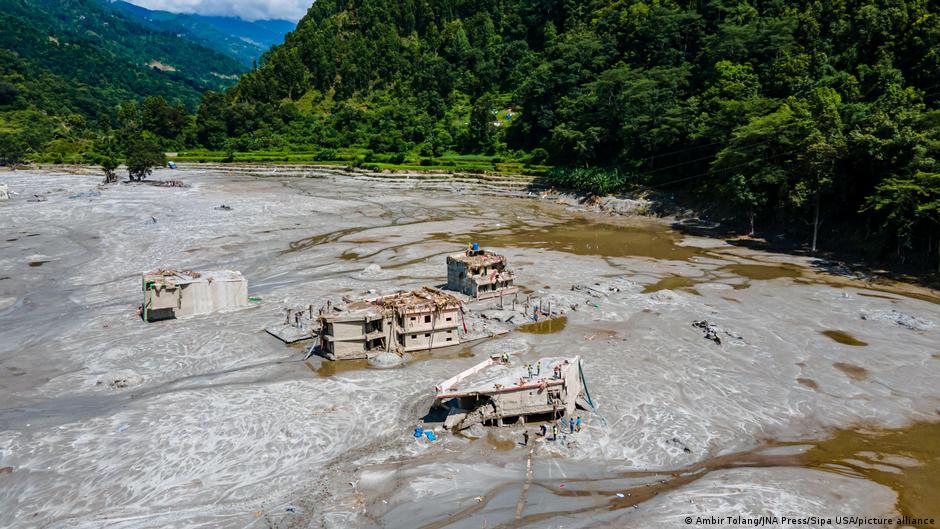
In the weeks since catastrophic floods ravaged Nepal’s Bhotekoshi‑Trisuli river basin, the full extent of the devastation is still coming into view.
The death toll has surpassed 1,250, while nearly 4,000 people remain unaccounted for.
Widespread destruction has levelled buildings, bridges, roads and more than a dozen hydropower plants, inflicting an estimated $2.6 billion (€2.24 billion) in losses to both public and private infrastructure, according to the National Disaster Risk Reduction and Management Authority (NDRRMA).
Search‑and‑rescue missions continue as families hold onto hope for the safe recovery of their loved ones.
While the precise trigger of the glacial collapse remains uncertain, scientists warn that climate‑driven melting of glaciers worldwide is heightening the likelihood of similar catastrophes.
Floods Trap Hundreds Inside Nepal Hydropower Tunnels
To view this video please enable JavaScript, and consider upgrading to a web browser that supports HTML5 video
A Global Responsibility?
For Nepal, the disaster has posed a question that extends far beyond rescue and rebuilding efforts.
It centers on climate justice: who should bear the costs and responsibilities for such environmental catastrophes when the Himalayan nation accounts for only a minuscule share of global greenhouse‑gas emissions yet confronts ever‑intensifying climate‑related threats.
Nepal’s Prime Minister Balendra Shah declared that responding to the catastrophe is a “global responsibility.”
“As we work tirelessly to address the damage caused by this sudden and massive disaster, a deeper question has also emerged: How did this destruction happen to us?” Shah asked in his address to parliament this week.
He emphasized that mitigating and managing its impacts must be regarded as a shared responsibility of the international community.
Kathmandu intends to raise climate‑justice concerns at the upcoming United Nations General Assembly in New York, where Prime Minister Shah is expected to lead the Nepali delegation.
“We will present our case on the impact of climate change and seek global support and moral commitment to address it,” Nepal’s Foreign Minister Shisir Khanal told DW. “We will also take the lead in forming a coalition of climate‑vulnerable nations to amplify our collective concerns.”
Survivors Return to the Ruins of Their Homes After Nepal Floods
To view this video please enable JavaScript, and consider upgrading to a web browser that supports HTML5 video
Extreme Vulnerability to Climate Impacts
Nepal, a predominantly rural nation of roughly 30 million people, has contributed minimally to the greenhouse‑gas emissions fueling global warming.
The country accounts for merely 0.1 % of global greenhouse‑gas emissions and releases about 0.5 tons of CO₂ per capita annually, a level the World Bank describes as a “negligible contributor to climate change.”
Yet the landlocked Himalayan nation is acutely vulnerable to climate change, facing floods, landslides, glacier‑related hazards and other environmental risks that threaten lives and livelihoods.
Nepal’s leaders assert that the country requires sustained international assistance to adapt to a rapidly shifting mountain environment.
The government estimates that implementing adaptation priorities from 2025 to 2035 could demand up to $18 billion–$20 billion, and Kathmandu is seeking the bulk of this funding from international climate finance mechanisms.
For years, Nepal has advocated in global climate forums that vulnerable mountain nations deserve greater support for adaptation and resilience.
In December 2009, Nepal convened a historic cabinet meeting at Kala Patthar, near Mount Everest’s base camp at an altitude of 17,192 feet, to underscore the threats that climate change and glacial melt pose to Nepal and other mountainous nations.
Bimala Rai Paudyal, a former Nepali foreign minister, said the recent disaster signals “an opportune moment to highlight glacier melting and climate‑justice issues in international climate forums.”
“Previously, we were only advocating about climate impacts. Now, we are suffering heavily from them,” she told DW.
Paudyal believes Nepal is well placed to spearhead an alliance of vulnerable nations, given its firsthand exposure to climate risk as well as its expertise and contributions to climate‑justice efforts.
Families Hold Onto Hope as Thousands Remain Missing in Nepal
To view this video please enable JavaScript, and consider upgrading to a web browser that supports HTML5 video
A Chance for Global Climate Action?
Kathmandu has formally applied to the United Nations Framework Convention on Climate Change (UNFCCC)‑backed “Loss and Damage Fund” for assistance in response to the recent floods.
However, the fund, established by the UN in 2025 to aid climate‑impacted nations, has yet to begin disbursing its limited resources.
The fund depends on voluntary contributions and lacks legally binding commitments under existing international climate accords, meaning major emitters such as China, India and the United States are under no direct obligation to compensate for climate‑change impacts.
Nevertheless, some observers and climate advocates contend that Nepal can make a compelling case for urgent global climate action.
“Nepal can turn this tragedy into an opportunity for global climate action,” said Dinesh Paudel, professor of sustainable development at Appalachian State University in North Carolina. “To do so, Nepal must build consensus among national stakeholders and navigate carefully, taking geopolitical factors into account.”
He argues that Kathmandu can forge an ethical movement for climate justice by spotlighting the recent flood, which could ultimately pave the way for an effective, legally binding mechanism to address climate impacts in the future.
Ashok Swain, professor of peace and conflict research at Uppsala University and UNESCO Chair on International Water Cooperation, shares a similar perspective.
“Nepal should not be left to bear the cost of a climate crisis it did little to create, nor for regional non‑cooperation over which it has limited influence,” he said. “This is not a matter of charity. It is fundamentally a question of climate justice and a fair distribution of responsibility.”
Also Read
- Following CIA Director’s Moscow Visit, Putin Intensifies Push for Military Victory
- Twenty One Pilots Tops Billboard Vinyl Albums Chart With Live Record
- South Korea considers ‘military contributions’ in Strait of Hormuz
- UN General Assembly Set to Consider African-Led Initiative for a More Accurate World Map