






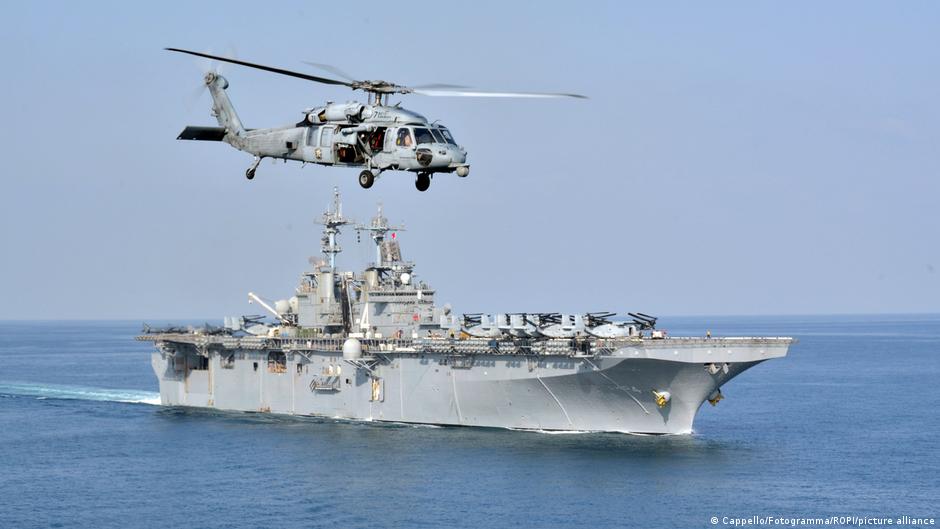
Once again, Gulf states find themselves caught in the crossfire between the United States and Iran.
The hostilities resumed in late February after the United States and Israel launched attacks on Iran. Although the United States and Iran signed a memorandum of understanding in June to halt fighting, both sides have since accused each other of violating the pact, and combat has reignited. The United States has carried out airstrikes against Iran, and Iran has retaliated by targeting U.S. allies throughout the Middle East, primarily Gulf nations.
Even when a country is not directly struck, every Gulf state faces significant risks if the conflict escalates further.
US, Iran exchange strikes for second night
To view this video please enable JavaScript, and consider upgrading to a web browser that supports HTML5 video
Bahrain
Bahrain hosts a major U.S. Navy base, and recent Iranian strikes hit the country directly.
Because Bahrain is one of the smaller Gulf states, U.S. military facilities are situated close to residential and commercial districts, meaning even limited fighting can disrupt civilian life.
Politically, Bahrain faces a delicate situation. Like its neighbors, it is a monarchy that suppresses most dissent, but its ruling family is Sunni while a majority of the population is Shiite. Iran, a Shiite theocracy, fuels internal tensions. The Bahraini government has detained hundreds of individuals accused of posting anti‑war messages, expressing sympathy for Iran, participating in demonstrations, or allegedly acting as Iranian spies.
Kuwait
Kuwait hosts the largest concentration of U.S. bases in the Middle East, including two air bases and roughly 13,500 personnel, contractors included. This makes Kuwait a target for Iranian attacks.
Historically, Kuwait adopted a cautious foreign‑policy stance, often positioning itself as a mediator and emphasizing a desire to stay out of the current conflict—a perspective shaped by Iraq’s 1990 invasion. However, Iranian strikes against Kuwaiti U.S. installations appear to be shifting that attitude, with the Kuwaiti government’s protests becoming noticeably more assertive.
Saudi Arabia
Saudi Arabia houses a major U.S. air force base.
After years of competing with Iran for regional influence, Saudi officials stress that diplomacy must prevail for Gulf nations to coexist peacefully.
The kingdom prefers to focus on its Vision 2030 economic agenda rather than become embroiled in a war it claims it never wanted.
Preventing the conflict from spreading and safeguarding critical oil infrastructure remain top priorities. Iran’s blockage of the Strait of Hormuz has forced Saudi Arabia to reroute some oil exports through a pipeline that connects to the Red Sea.
Saudi leaders have attempted to strike a careful balance, maintaining direct contacts with both Iran and the United States. At one point, Saudi Arabia denied the United States use of its airspace for bombing Iran, though later reports suggested Riyadh may have carried out its own covert strikes.
Can Gulf nations close the gap between Iran and the US?
To view this video please enable JavaScript, and consider upgrading to a web browser that supports HTML5 video
United Arab Emirates
The United Arab Emirates also hosts a key U.S. air base.
Renewed fighting threatens to tarnish the reputation of Abu Dhabi and Dubai as global financial and commercial hubs—an image vital to the Emirati economy, which is increasingly diversified beyond oil.
While the UAE has managed to divert some oil exports from the Strait of Hormuz via an inland pipeline, prolonged conflict could jeopardize that arrangement.
Qatar
Qatar is home to Al Udeid Air Base, the largest U.S. military installation in the Middle East. It also maintains relatively good relations with Iran, sharing a large natural‑gas field.
An Iranian attack on a Qatari vessel was among the incidents that precipitated the latest round of bombing.
Qatari diplomats, often praised as some of the world’s most effective, have repeatedly acted as mediators during the U.S.–Iran conflict, including in drafting the June memorandum that temporarily halted hostilities.
Oman
Oman does not host a major U.S. military installation but has maintained strong ties with both the United States and Iran, serving as a conduit for back‑channel diplomacy. Like Qatar, Oman could play a vital role in future negotiations.
This article was originally published on July 8 and updated on July 13 to reflect new strikes on Iran and U.S. bases in the region.


