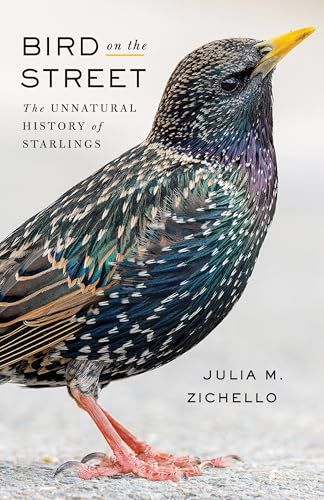
In the late nineteenth century, Eugene Schieffelin, an amateur ornithologist and chairman of the American Acclimatization Society, released roughly 100 European starlings (Sturnus vulgaris) into New York City’s Central Park. The society aimed to transplant European flora and fauna across North America. The introduction proved catastrophic. Within decades the birds had colonized their new habitat and spread across the continent; by 1970, less than a century after their release, their numbers had climbed to approximately 200 million.
Yet this explosive spread exposed something extraordinary about one of the world’s most successful invasive birds: its capacity to evolve. In this adapted excerpt from “Bird on the Street: The Unnatural History of Starlings” (Columbia University Press, 2026), evolutionary biologist Julia M. Zichello describes a turning point in her research into the species’ adaptability—the arrival of a box of dead starlings.
Across the United States, wildlife management agencies cull starlings every year at airports and agricultural sites to limit crop damage, protect livestock, and reduce bird strikes. The birds are dispatched by trapping, gassing, poisoning, or cervical dislocation.
Under U.S. law, unpermitted individuals may legally kill starlings, unlike most other bird species. In 2014, Zichello emailed the USDA Animal Control Unit to request starling specimens for her research.
She recalls a wildlife specialist answering the phone, cautiously professional but clearly baffled by the request. To them, the starlings were literal trash. Nevertheless, they shipped the birds to her anyway—packed in a box labeled “Honey Baked Ham.”
The USDA kills roughly two million starlings annually in the United States. Zichello now had five of them.
Minor anatomical differences among members of the same species—known as intraspecific diversity—can arise from developmental or evolutionary mechanisms. Age is an obvious example: an older bird’s anatomy differs from a juvenile’s. Hormones also drive anatomical distinctions between the sexes.
Other variations among individuals of the same species, independent of age and sex, can reveal fundamental truths about evolution. This is microevolution: the process by which variation within a species is shaped by mutation, natural selection, the founder effect, migration, and genetic drift.
These evolutionary forces operate over different timescales and intensities, sometimes converging and sometimes opposing one another. Quantifying how much each force contributes to the genetic and physical diversity we observe within a species remains one of the oldest and most central questions in evolutionary biology. Some processes generate variation between individuals; others erase it.
Mutation is a creative force. Despite its largely negative reputation, it can produce new gene variants that prove advantageous under particular environmental conditions. Every new offspring carries a handful of novel mutations, which may be beneficial, harmful, or—most commonly—neutral. Mutation generates fresh variation in a population, making each individual slightly different from its parents.
The founder effect occurs when a small group breaks away from a larger population to establish a new one. This typically reduces genetic diversity in the new group, allowing certain gene variants, or alleles, to rapidly increase in frequency.

That rise in frequency does not happen because the allele is beneficial; it happens because it is the only variant available. This sampling effect, known as genetic drift, is especially powerful in small populations. While the founder effect’s influence on genetic variation is well documented, its impact on physical traits remains far more complex and mysterious.
Part of the challenge is that a single physical trait—such as wing length—is governed by many genes simultaneously. Gregor Mendel’s nineteenth-century experiments with pea plants established a one-gene, one-trait model for features like flower color or seed texture, but most complex traits do not follow that simple pattern. This non-Mendelian complexity only deepened Zichello’s interest in how starlings may have changed physically over time because of the founder effect.
Patterns of variation—or their absence—serve as evolutionary clues, hinting at events in the species’ past. Pinpointing exactly what happened is one of the inherent difficulties of historical sciences such as evolutionary biology.
Historical records show that the U.S. starling population began with roughly 100 birds and has since expanded to roughly 93 million. Zichello’s central question: Do starlings lack genetic and phenotypic diversity because their dramatic population history was shaped by human intervention?
To a casual observer, birds within a starling flock look nearly identical—glossy, uniform little soldiers pecking at grass or moving in unison. Zichello needed to measure their differences and similarities, because science requires more than casual observation.
This approach—studying a living species to peer backward in time—made those five dead starlings invaluable. She could dissect them, extract DNA from tissue samples, or preserve them as future research specimens. “It was evolution in a garbage bag,” she says.