



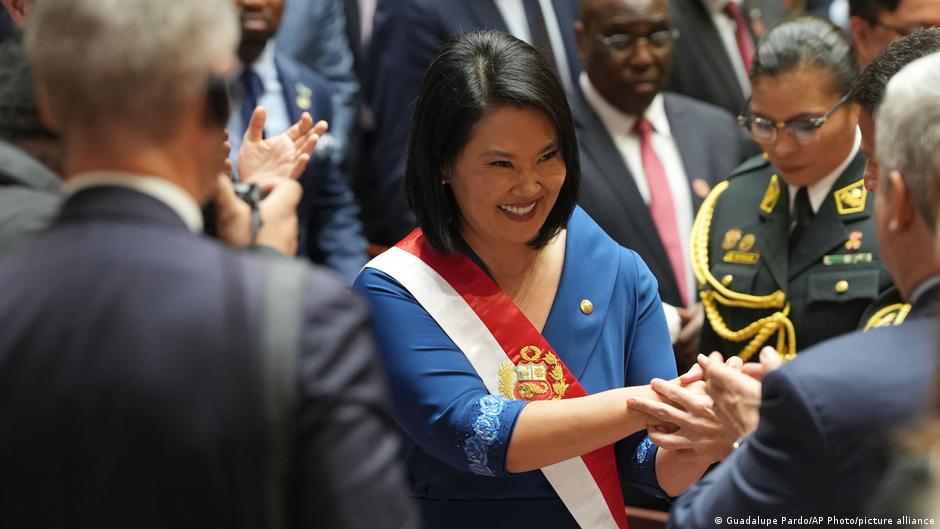
Keiko Fujimori’s inauguration on Tuesday marked the resurgence of a political movement that had been out of power for over a quarter century.
Fujimorism, an ideology blending neoliberalism, populism, and strict governance, defined the 1990–2000 presidency of her father, the late Alberto Fujimori. Keiko Fujimori assumes the presidency amid social polarization, pledging to enhance security, spur economic recovery, and improve health and education systems.
Beyond these domestic priorities, Fujimori steps into a role of heightened strategic importance for Peru. The nation has become a central arena in the intensifying competition between Washington and Beijing for influence across South America.
Hardline Approach to Crime
Fujimori has signaled that security will be the paramount priority for her administration.
The agenda includes expanded video surveillance, a bolstered police presence, stricter penalties for crimes and organized gangs, and nationwide command and control centers.
Part of this crackdown involves the construction of four mega-prisons, modeled after those in El Salvador.
Eliana Carlin, a political science expert at the Pontifical Catholic University of Peru in Lima, expressed concern about how Fujimori’s plans could impact human rights.
“Behind these measures lie strong ideological positions intended to justify placing the police and armed forces solely under military jurisdiction,” she stated.
Beyond security, Fujimori also intends to advance infrastructure projects, attract private investment, construct new schools and hospitals, and modernize the nation through technology and artificial intelligence.
However, fulfilling these pledges depends largely on whether the government can secure the necessary funding. Infrastructure and essential services continue to face severe deficits. Compounding this are the surging crime rate and the looming threat of a strengthening El Niño weather pattern, which could bring increased drought, extreme heat, flooding, and other climate-related disruptions to Peru.
How a ‘Super El Niño’ Could Alter Global Weather Patterns
To view this video please enable JavaScript, and consider upgrading to a web browser that supports HTML5 video
Peru as a Strategic Player in South America
The opening of the Chancay port and logistics hub has elevated Peru to a strategic player in regional trade, placing it at the center of the geopolitical rivalry between Washington and Beijing.
The estimated $3.5 billion project is part of China’s global Belt and Road Initiative. Once fully operational, the port is expected to slash shipping time between Peru and China from roughly 40 days to around 23 days, turning Chancay into a vital new gateway to Asia.
Thanks to the port and other investments, China has become Peru’s most vital trading partner. Bilateral trade between the two countries exceeded $40 billion in 2024, official figures show. The United States ranks second, with nearly $25 billion in trade.
Michael Shifter, an adjunct professor at Georgetown University specializing in Latin American politics, stated that much is at stake for Peru.
“Beijing has played a pivotal role in the Peruvian economy for years, even as the United States seeks to expand its influence. Nowhere is this competition between Beijing and Washington more apparent than in Peru,” he told DW.
Why Is China’s New Megaport in Peru Facing Pushback?
To view this video please enable JavaScript, and consider upgrading to a web browser that supports HTML5 video
According to Shifter, the Chancay port will be crucial for Peru and its regional neighbors.
“It will reduce transportation costs and facilitate trade with Asia, especially with China,” he said. “This project holds enormous potential for the future of the South American economy.”
Part of a planned “bioceanic” corridor linking Brazil and Peru, the Pacific hub at Chancay will connect to the Atlantic Ocean via rail and road projects, facilitating the export of products from across South America to Asia.
Balancing China and the US ‘Will Not Be Easy’
Fujimori has also announced plans to expand cooperation with the United States, particularly in security and the fight against organized crime.
For Shifter, the challenge will be maintaining the delicate balance between Washington and Beijing.
“Keiko Fujimori wants to align herself with Washington and avoid tensions with the United States. At the same time, China has been indispensable to the Peruvian economy for years, and the Chancay port enjoys broad domestic support. Balancing this relationship will not be easy,” he said.
To maintain favor with the U.S. administration, Peru’s participation in the so-called “Shield of the Americas” will be critical.
The alliance, initiated by Donald Trump to combat organized crime, has already fostered cooperation with right-wing governments in Argentina, Chile, Ecuador, and El Salvador.
According to Shifter, participation in the “Shield of the Americas” would also demonstrate closeness to the Trump administration.
Peru’s New Role in Latin America
Fujimori’s inauguration comes at a time when conservative forces have gained influence across several Latin American countries. Shifter notes, however, that Peru’s case remains unique.
“It is tempting to interpret her election victory as yet another rightward shift in Latin America. But Peru is more complex than that. Keiko Fujimori has shaped Peruvian politics for decades, and the country had already been pursuing a pragmatic course,” he said.
Political scientist Carlin, however, fully anticipates a foreign policy shift.
“Fujimori has already made it clear that she wants to align more closely with the United States and other conservative governments. I anticipate Peru adopting a tougher foreign policy stance, but I don’t believe Peru can do without China,” she said. “A break with Beijing would not be realistic.”
Also Read
- Zuckerberg predicts more jobs and entrepreneurship if superintelligence is widely distributed
- Rising Water Scarcity: Emerging Flashpoints for Regional Conflict Worldwide
- Microsoft Short Interest Surges to Ten‑Year High Ahead of Q2 Results Amid AI Investment Uncertainties
- Contested Kashmir Ballot Marred by Lethal Violence on Opening Day