






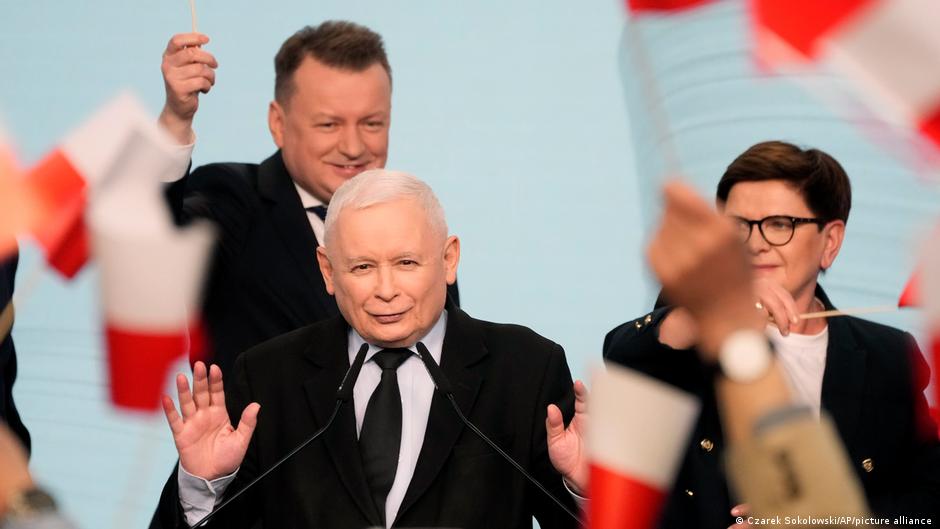
More than 30 members of the group have effectively renounced their membership,” said Jarosław Kaczyński, leader of the Law and Justice (PiS) party, on Friday. He accused former Prime Minister Mateusz Morawiecki and dozens of his supporters of trying to split the party.
“We cannot accept this,” Kaczyński added. “It’s over.” The dissenters maintained that they have not resigned but have been expelled.
A three‑hour “last chance” discussion between Kaczyński and Morawiecki concluded on Thursday with no outcome. “We sought dialogue but could not tolerate subjugation,” Piotr Mueller, an EU delegate aligned with Morawiecki, said on X.
Kaczyński’s ultimatum on the dissenting members expired at midnight. The rebels were expected to submit a written pledge to cease all activities within the Rozwoj Plus (Development Plus) association led by Morawiecki, which Kaczyński believes has weakened his party’s dominance.
Poland swings back to the right after presidential vote
To view this video please enable JavaScript, and consider upgrading to a web browser that supports HTML5 video
For 25 years, Kaczyński and his PiS party have dominated Poland’s right‑wing political landscape. Efforts to create a more radical right‑wing party have been thwarted. Since 2001, PiS has governed twice—first from 2005 to 2007 and again from 2015 to 2023—and has produced two consecutive state presidents: Kaczyński’s twin brother Lech, followed by Andrzej Duda, and, since mid‑2025, Karol Nawrocki.
Greatest crisis since party’s founding
Just over a year before the upcoming parliamentary election, the party faces its most severe crisis since its 2001 founding.
Two parties have now emerged to the right of PiS: the nationalist‑libertarian Confederation Liberty and Independence (KWIN) and the ultranationalist, traditionalist Confederation of the Polish Crown (KKP). Together they poll more support than PiS itself, and Kaczyński’s party has seen its voter base erode toward these radical factions.
Two lungs or one fist?
Czarnek seeks to outflank the two Confederation parties by attacking the EU and Ukraine verbally. Amid the recent Polish‑Ukrainian dispute over unresolved historical matters, he called for a suspension of all military aid to Ukraine until Kyiv alters its stance. Proponents of this hardline position argue that the party should act “like a fist.”
In response to the party’s rightward shift, Morawiecki founded the political association Development Plus and invited 1,000 guests from diverse political backgrounds to a late‑July policy event, where they can discuss the nation’s future over a barbecue.
The former prime minister has criss‑crossed the country, meeting local politicians and business leaders. As early as April, he clashed with Kaczyński, who accused him of jeopardizing party unity. At that time, however, the party leader supported Morawiecki’s initiatives and described the arrangement as “two lungs” within PiS. That compromise proved short‑lived.
Reaching out to new voters
During public appearances, Morawiecki has repeatedly stressed his commitment to staying within PiS. He says his aim is to broaden the party’s appeal to new voters and to secure a right‑wing victory in the 2027 election.
Only days ago, Morawiecki could count on the backing of 40 members of Poland’s lower house, the Sejm, and several EU delegates. However, it remains uncertain whether all will be able to resist Kaczyński’s pressure.
Opinion polls by Opinia24 for TVN and TVN24 on July 22 showed Morawiecki at 6.2% of the vote, while PiS support fell to 17.7%. In the 2023 parliamentary election, PiS, led by Kaczyński, captured 35% of the vote.
Where do Europe’s far-right parties differ?
To view this video please enable JavaScript, and consider upgrading to a web browser that supports HTML5 video
Among Kaczyński’s longtime associates who have worked with him since the 1990s, Morawiecki remains an outsider. After Poland’s democratic transition, the trained historian held senior roles at several banks before joining PiS in 2016.
While in power under PiS, he served as development minister, finance minister, and ultimately prime minister. Morawiecki and his allies accuse their opponents of plotting against them.
Gloating among the governing coalition
The center‑right coalition led by Prime Minister Donald Tusk has openly expressed amusement at PiS’s current predicament. ‘I love PiS so much I’d love to have two of them,’ Foreign Minister Radosław Sikorski joked upon hearing the news.
Political scientist Danuta Plecka said on Friday that the situation presented a ‘gift’ to the ruling government. ‘All recent scandals are fading into the background,’ she explained. ‘Tusk need not act; he can simply sit by the riverbank and wait for the bodies to float by.’
A researcher at the University of Gdańsk believes the clash between Kaczyński and Morawiecki may be a staged performance. ‘There are hardly any substantive policy differences,’ she told TVN. ‘Their main distinction lies in language and political tactics.’
This article was originally written in German.


