




This past summer, my AI-powered investment advisor, Mezzi, identified approximately $300,000 of concealed Google stock exposure that I was unaware of. While the figure may seem surprising, I have held Google shares for more than fifteen years, and managing a complex portfolio makes it easy to lose sight of true exposures when relying on outdated price anchors.
A few weeks after I reduced my holding, Google’s stock declined by roughly 10%. By acting on Mezzi’s insight, I avoided more than $20,000 in potential losses.
As an AI enthusiast, I constantly seek out innovative AI tools that can enhance wealth creation and promising private AI firms worth backing. Mezzi fulfilled both criteria, prompting me to become both an investor and an affiliate.
How I Discovered Mezzi: My AI Investment Advisor
Prior to the summer, I was introduced to Mezzi by Mark Goines, a longtime friend and former Personal Capital colleague. Mark is a prolific angel investor who also served as CMO at Intuit and Personal Capital during my consulting tenure there, giving him deep expertise in wealth management and personal finance.
Being fellow Cal alumni, Mark has consistently been courteous and supportive. When he emailed to connect me with Manish Jain, Mezzi’s co‑founder and CEO, I eagerly accepted a lunch meeting in West Portal to learn more about the company.
We rapported instantly, and Manish even drove me home, demonstrating his Tesla’s self‑driving features. I was also curious whether my home’s built‑in Tesla charger, installed when I purchased the property in 2023, would function properly—I had never tested it while deliberating a new‑car purchase. The charger performed as expected, though I have decided to retain my current vehicle for the time being.
Understanding Mezzi
Mezzi is an AI‑driven wealth advisor that consolidates your entire net worth in a single interface, learns your objectives and preferences, and enables you to interrogate your finances. You can query it about your portfolio, actual stock allocations across all accounts, fees, tax circumstances, and it responds with precise, real‑world figures.
Most importantly, it delivers a tailored recommendation. You can also set standing instructions for Mezzi to monitor, analyze, and alert you on specific items—a valuable feature given how easy it is to overlook details amid life’s demands.
Think of Mezzi as a perpetual financial analyst that views your total net worth across every institution, rather than a static dashboard that only posts results after the fact.
In an upcoming detailed review, I will examine all of Mezzi’s features. For now, here’s what occurred when I applied the tool to my own finances.
Evaluating Mezzi Before Rebalancing and Investing
Following our lunch, I downloaded the Mezzi app and uploaded the majority of my equity portfolios to assess its capabilities.
My primary expectation for any wealth‑management platform is interactivity. While a snapshot of holdings and asset allocation is useful, I have an incessantly curious mindset that enjoys forward‑looking, scenario‑based thinking, constantly weighing present actions against future outcomes to grow wealth.
I hoped Mezzi would serve as a convenient AI layer for wealth management, capable of answering specific portfolio queries. It delivered on that promise. As I continued using it, I linked additional portfolios, real‑estate holdings, bank accounts, and credit cards. After several months of regular use, I can confidently say Mezzi is the AI wealth‑management solution I have been seeking.
I then asked Manish whether I could invest in the company; he agreed, and I proceeded.
What reassures me is that Mezzi was not launched merely to chase the AI trend. Manish and his team have been developing the company and its product for the past three years, allowing ample time to incorporate user feedback and refine the offering. Moreover, Mezzi is SEC‑registered.
I have received numerous partnership offers over the years. My rule is to decline any collaboration with firms lacking at least a two‑year track record, as many vanish quickly. I prioritize longevity when choosing tools to use and endorse.
It also helped that I finally connected the dots.
With AI’s ascent, distribution remains one of the final competitive moats. After seventeen years of building Financial Samurai and serving as a limited partner in venture‑capital funds, I recognize that I ought to have been investing directly in AI startups within my expertise all along, leveraging my platform to support their success—better late than never.
Using the remaining capital from my Summer YOLO Fund, I allocated funds to Mezzi and anticipate a long, productive partnership.
How Mezzi Helped Me Avoid Over $20,000 in Losses
A clear view of your finances is essential for identifying optimization opportunities, yet acting on that insight can be challenging due to the many variables involved. For someone like me—holding a complex net worth spread across more than forty accounts for four individuals—determining the right course of action can feel overwhelming.
I therefore adopted a rational approach, beginning with my largest holdings. At that point, my biggest individual public‑stock position was Google.
My former employer acted as a book‑runner for Google’s 2004 IPO, and I have been accumulating shares ever since. After leaving my job in 2012, I added to my position. Having applied for several Google roles while collecting unemployment—without success—I invested $25,000 in Google stock, reasoning that if I could not work for Google, at least Google could work for me as a shareholder.
At that time, I was not willing to accept a position unless it offered an excellent fit and strong compensation. I was going through the motions of applying to seven jobs per week and reporting them to the unemployment office to collect my $950 bi‑weekly benefit. After thirteen years in finance, I felt burnt out and needed a hiatus, yet I kept the possibility of returning open.
Fourteen years later, I estimated that my Google holdings had grown to between $900,000 and $1,000,000, spread across my rollover IRA, 401(k), SEP IRA, and taxable brokerage account.
Or so I believed.
ETF Overlap Reveals My Actual Google Exposure
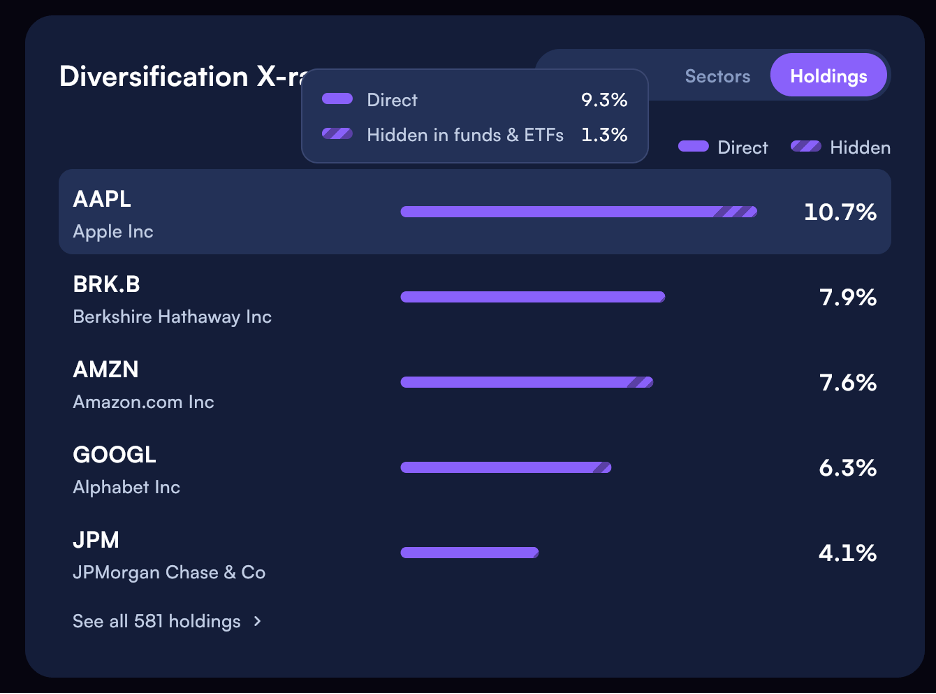
After connecting the final equity portfolio, I requested that Mezzi analyze my true individual stock weightings. The analysis showed my Google exposure was nearer to $1.3 million. Since Google constitutes about 6% of the S&P 500 and the majority of my public equity holdings reside in S&P 500 ETFs, my index funds were silently adding Google on top of my direct holdings all along.
For years I underestimated my Google exposure, which is risky because every subsequent asset‑allocation decision rests on that assumption. Leveraging its Diversification X‑ray, Mezzi advised me to trim my weighting; I acted on that guidance by selling $200,000 of Google from my tax‑advantaged accounts and reinvesting the full proceeds into an S&P 500 ETF, a position that has remained stable.
Within weeks, Google’s Chief Scientist Jeff Dean and several senior colleagues departed, and the stock slipped about 10%. By following Mezzi’s analysis, I avoided more than $20,000 in losses. While market‑moving news cannot be forecasted, you can manage your exposure—but only to the extent you can see it.
Looking back, I would have been better off selling $300,000 of Google shares, given that the stock has continued to fall.
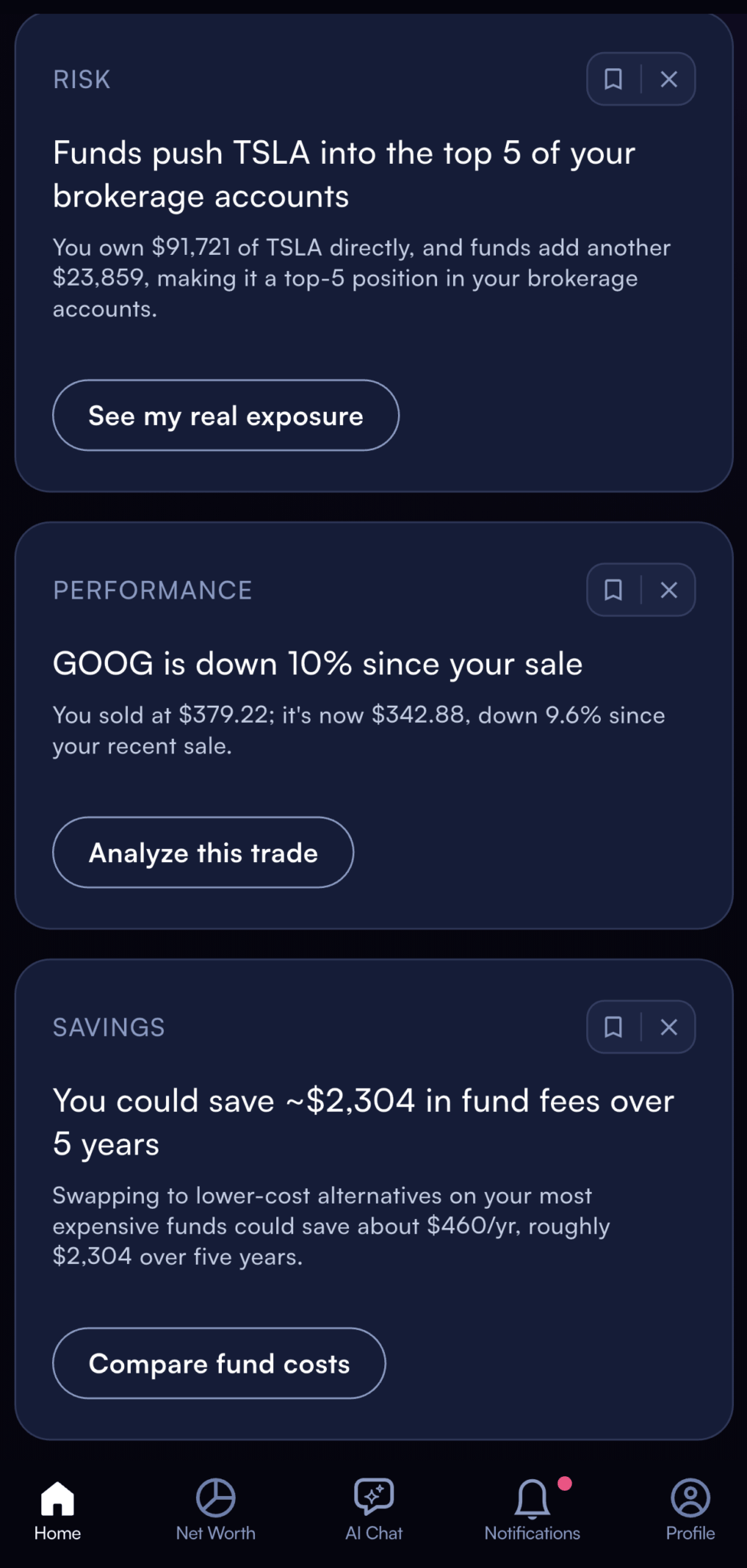
How Perception Skews Investment Judgment
I also employed Mezzi to examine my losing positions, and the results were surprising.
I believed my Nike position had lost roughly $10,000—a typical value trap—yet the actual loss was nearer to $20,000. Had I considered more carefully the timing and amount invested during the August 2024 Summer Olympics, my assessment might have been more accurate. Over time, however, it is tempting to overlook losing positions because they are unpleasant to monitor.
Mezzi helped me confront the reality. I sold sufficient Nike shares at a loss to counterbalance long‑term capital gains from other transactions. Mezzi can also generate a comprehensive sale strategy aimed at minimizing capital‑gains tax.
Mezzi as My Interactive Wealth‑Management Companion
I will continue to use Mezzi as my interactive guide to remain honest about my investment performance and risk. It is all too easy to overestimate our investing abilities. As portfolios expand in size and complexity, an interactive AI wealth advisor becomes indispensable.
Try Mezzi to uncover any blind spots or opportunities in your own portfolio.
Getting started is free, and if you have questions you can email founder Manish Jain directly at manish@mezzi.com—let him know Sam referred you. He will provide a guided tour, demonstrate how to maximize the platform, and answer any other queries. Few founders extend this level of accessibility.
He has also extended a 30 % discount on the first year of Mezzi membership to my readers. Use the code FS30 to receive 30 % off the premium‑plus tier.
Next week I will release a detailed Mezzi review that covers all of its features. Please stay tuned.
Disclosure: StockTalk Inc., operating as Mezzi, is an SEC‑registered investment adviser. I am an investor and affiliate of StockTalk Inc. All views and portfolio numbers reflected herein are my own, and I only collaborate with firms whose products I personally use. This content is for informational purposes only and does not constitute personalized investment advice, a securities recommendation, or an offer of advisory services. SEC registration does not indicate any particular level of skill or training. Past performance is not a predictor of future outcomes. Third‑party ratings, reviews, rankings, testimonials, or endorsements may be unaffiliated, subjective, not necessarily reflective of all client experiences, and should not be taken as a guarantee of future performance.
Also Read
- Why NuScale Power Could Deliver Stronger Near-Term Upside Than Oklo
- Video: Dozens protest potential Strait of Hormuz deployment
- German Chancellor Friedrich Merz Slams AfD’s ‘Remigration’ as ‘Ethnic Cleansing’ Following State Election Shock
- Singapore Prime Minister’s Compensation Set for 64% Increase Under New Pay Framework