







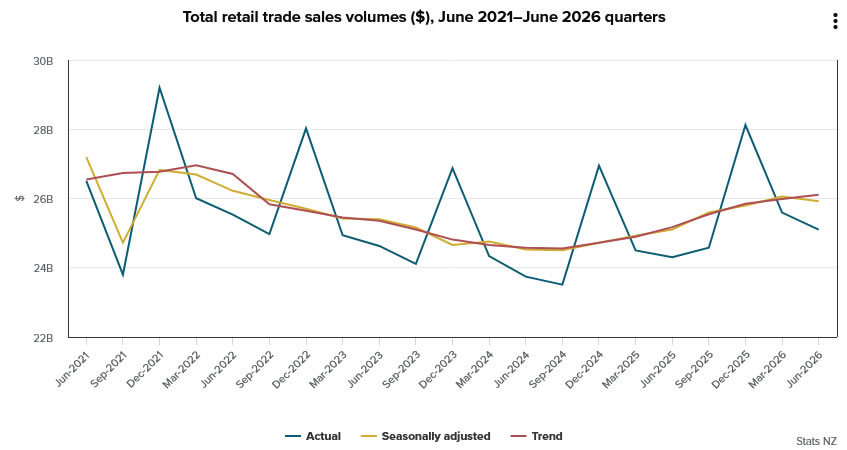
New Zealand retail sales volumes slipped 0.5% quarter‑on‑quarter in the second quarter, erasing a revised 1.0% gain in Q1 and coming in below the 0.1% rise forecast. When autos are excluded, however, sales rose 0.7%, a slowdown from a revised 1.1% increase but still comfortably ahead of the 0.3% consensus. Eight of the fifteen industries recorded lower volumes, suggesting a mixed rather than uniformly weak performance across the sector.
The most significant drag on retail activity came from fuel retailing, where volumes collapsed by 13%. Accommodation services fell 8.0%, food and beverage services were down 2.8%, and motor‑vehicle and parts retailing declined 2.3%. In contrast, electrical and electronic goods retailing rose 9.2%, providing a modest offset. While the weakness was not confined to autos, the sharp drop in fuel volumes disproportionately weighed on the headline figure.
Price movements sharply differentiated the nominal and real pictures. Seasonally adjusted retail sales values increased 0.9% quarter‑on‑quarter to NZ$33 billion, even though actual volumes fell. Fuel retailing values jumped 12% despite a 13% drop in volumes, a result Statistics New Zealand attributed to higher fuel prices. This divergence indicates that households spent more on fuel while buying less, making nominal spending appear stronger than the underlying consumption trend.

Data Summary
Indicator
Actual
Expected
Previous
Retail Sales q/q Q2
-0.5%
+0.1%
+1.0%
Retail Sales ex Autos q/q Q2
+0.7%
+0.3%
+1.1%
Key Takeaways
- New Zealand retail sales volumes fell 0.5% q/q in Q2, reversing 1.0% growth in Q1 and missing the expected 0.1% increase.
- The underlying picture was stronger than the headline, with ex‑auto sales rising 0.7%—ahead of the 0.3% consensus—despite a slowdown from a 1.1% rise.
- Fuel was the biggest drag on real activity, with volumes plunging 13%; accommodation fell 8.0%, food and beverage services declined 2.8%, and motor‑vehicle and parts sales dropped 2.3%.
- Higher prices sharply distorted nominal figures. Fuel retailing values jumped 12% even as volumes fell 13%, helping total retail sales values rise 0.9% q/q.
- The report points to softer real consumption at the headline level, but not broad‑based spending weakness, as price effects—particularly fuel—mask the decline in physical purchases.
Also Read
- Bitcoin holders face unresolved fork risks as new eCash test chain launches ahead of October deadline
- NZD/USD Price Outlook: Bulls Eye 0.6000 Breakout Amid Consolidation Near June Peaks
- Silver (XAG/USD) Holds Bullish Bias Below $70 After Recent Two‑Month High
- Elliott Wave Analysis Signals Continued XAUUSD Bullish Momentum Above Key Support Levels


