







Thailand is proposing a new exchange-traded fund (ETF) framework for cryptocurrencies that would provide domestic fund managers, the Stock Exchange of Thailand (SET), and locally regulated custodians with a distinct structural advantage as the country opens its market to Bitcoin and Ethereum products.
On August 24, Thailand’s Securities and Exchange Commission (SEC) launched a public consultation on rules that would initially permit passive, single-asset funds focused on Bitcoin or Ethereum. Under the proposal, each fund would be required to maintain an average net exposure of at least 80% of its net asset value to the underlying asset throughout the accounting year.
The proposed products would enter a market already proven by the success of crypto ETFs in the United States, which have attracted over $60 billion in net inflows since their launch. Bitcoin ETFs dominate with approximately $54 billion, followed by Ethereum products at around $12 billion, with newer crypto ETF offerings accounting for the remainder.
Thailand’s proposal aims to bring this established model onshore, keeping a significant portion of the initial value chain within the country’s borders.
Local Thai firms to receive initial advantages
Under the new framework, locally established crypto ETFs would trade exclusively on the Stock Exchange of Thailand. Additionally, their assets would initially need to be held primarily by digital-asset custodians regulated by the Thai SEC.
The proposal does not ban foreign crypto products entirely. Mutual and private funds are already permitted to invest in overseas crypto ETFs under existing regulations. Meanwhile, the SEC is conducting a separate consultation on a framework that could eventually allow qualified foreign custodians to operate.
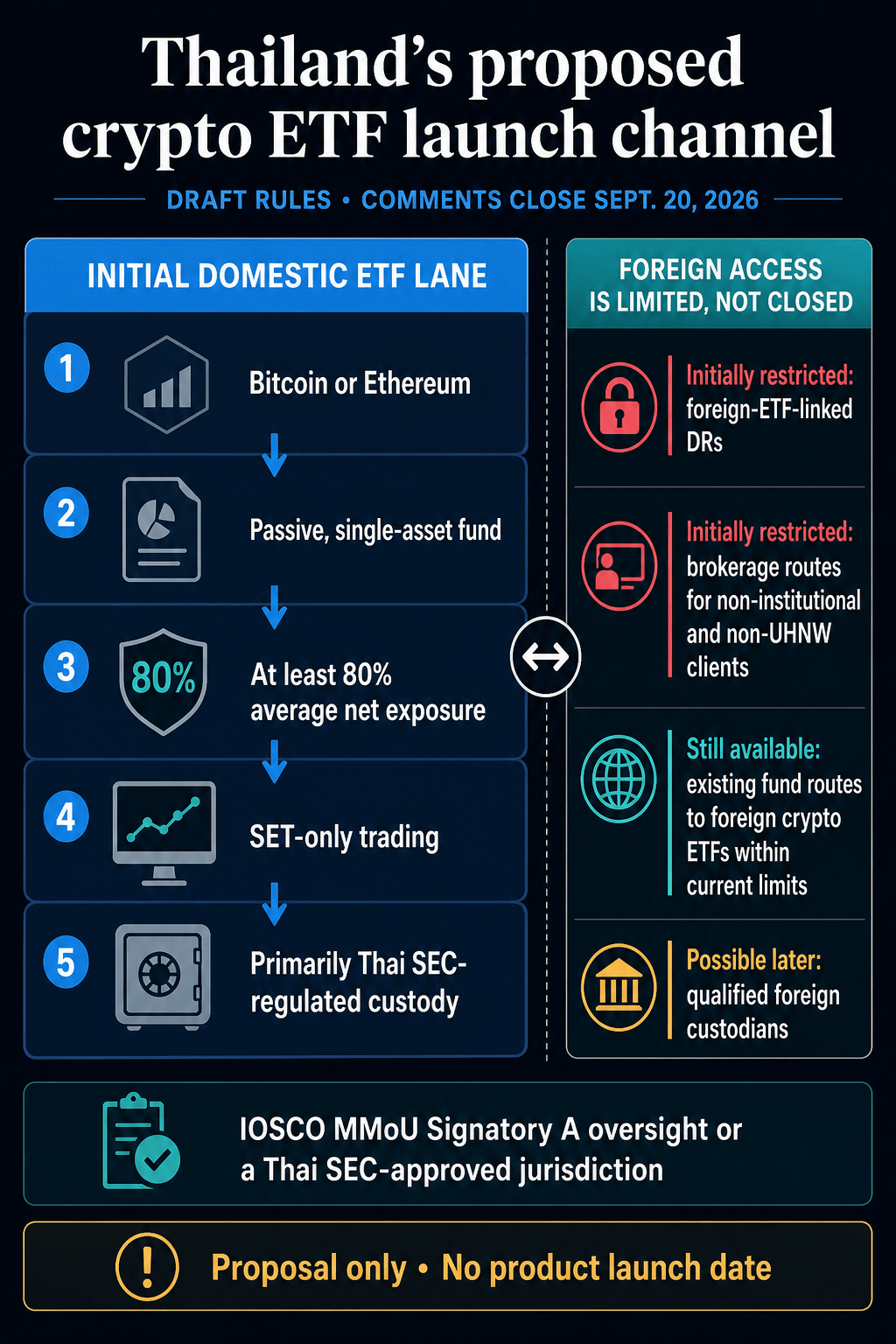

Thailand would also initially restrict certain alternative products linked to foreign crypto ETFs, including depositary receipts referencing them and specific securities-company arrangements for clients outside of institutional and ultra-high-net-worth categories.
This approach would make locally domiciled ETFs the primary retail-facing route under the proposed framework, while preserving some existing access to foreign products.
The SEC’s current registry lists Rakkar Digital and Orbix Custodian among licensed custodial wallet providers, while Soberin, Orbix Invest, and Merkle are registered digital-asset fund managers. Thailand also hosts 24 licensed mutual-fund management companies.
These firms are well-positioned to compete for key roles if the framework is finalized, although the consultation does not specify any ETF applicants, custodian mandates, or likely beneficiaries.
Investors would also face product-risk education and acknowledgment requirements before trading, while intermediaries would be expected to assess diversification, risk tolerance, and financial capacity.
Public comments on the proposal are due by September 20. The SEC expects the related rules to take effect later in 2026, though no specific ETF launch date has been announced.
In summary, the proposal opens the door to local Bitcoin and Ethereum ETFs while deliberately centering the initial market around Thai-regulated institutions.
Also Read
- Gold Pulls Back From Three-Month Peak Near $4,600 Following US PCE Inflation Report
- JPMorgan Actively Exploring Stablecoin Launch Despite Regulatory Concerns
- GBP/JPY Nearterm Technical Setup Points to Key Support at 216.00 as Evening Star Pattern Emerges
- Japanese Yen Weakens Ahead of Tokyo Inflation Data Amid Risk-On Mood


