



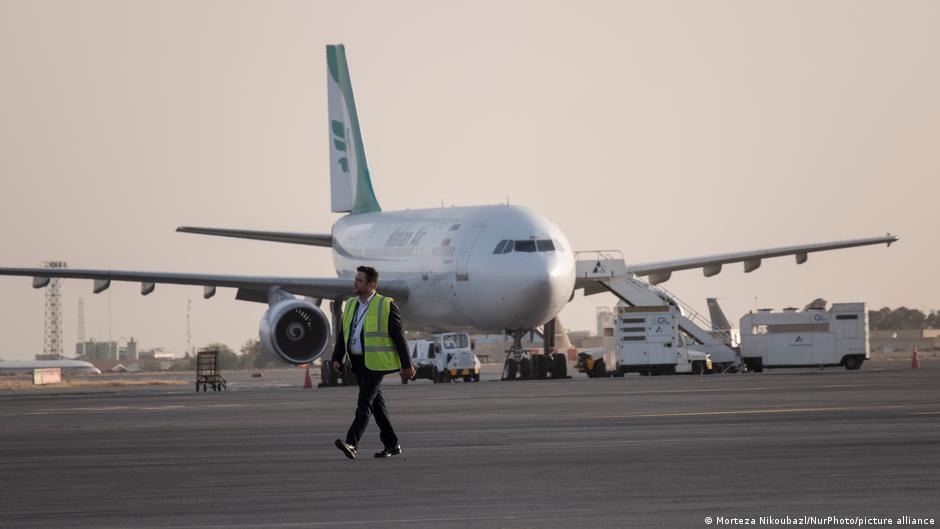
US sanctions are driving Iran’s already fragile aviation sector further into isolation, increasing uncertainty for international travel and compounding risks for trade and cargo operations.
In early September, as part of its “economic outcast” campaign, the US Treasury targeted Iran’s aviation industry—including Iranian airlines and firms handling ground services, ticketing, and airport operations—exposing them to secondary sanctions and potential exclusion from the US financial system.
While Washington cannot compel foreign airports to refuse Iranian aircraft, the threat of secondary sanctions makes servicing them too hazardous for airports, fuel suppliers, and aviation companies.
For Tehran, these aviation restrictions add another dimension to broader US pressure, complementing curbs on banking, shipping, insurance, and trade.
US officials argue that Iranian airlines have served not only civilian passengers but also military and security networks.
Mahan Air, for instance, has been accused of aiding the Islamic Revolutionary Guard Corps (IRGC) and facilitating the movement of personnel and equipment.
The issue is not uncontested inside Iran. Former Foreign Minister Mohammad Javad Zarif noted in a 2021 interview that Qassem Soleimani had used civilian aircraft to transfer forces and materiel to Syria.
For Washington, such connections justify targeting aviation networks; for ordinary travelers, the immediate consequence is canceled flights and diminished options for entering or leaving the country.
Major Middle East routes canceled
Iranian services to Baghdad and Muscat have been suspended or canceled, and Azerbaijan and Georgia have halted flights by Iranian carriers. An Iranian travel agency, speaking anonymously for safety reasons, told DW that routes to Oman, Iraq, Azerbaijan, and Georgia have been severely disrupted.
On September 24, Turkmenistan denied an Iranian aircraft flying from Tehran to Dushanbe permission to cross its airspace, forcing the plane to turn back.
Turkey, Armenia, and China have not imposed blanket bans, the agency said, but passengers are increasingly reluctant to book tickets because even confirmed reservations no longer guarantee departure.
Is Iran set to become an economic outcast?
To view this video please enable JavaScript, and consider upgrading to a web browser that supports HTML5 video
A passenger told DW that agencies continued to sell tickets but could not guarantee the flights would actually operate.
Under the sanctions package, the US also suspended the J-1 general license, which had permitted certain non-Iranian aircraft to make temporary stops in Iran provided foreign operators retained control and stays remained within limits.
Because many commercial aircraft contain US-made parts or technology, operations involving Iran can trigger US sanctions.
The J-1 suspension has heightened legal and financial risks for airlines, airports, fuel suppliers, ground-handling firms, and other service providers, all of whom must now weigh the threat of secondary sanctions.
More travelers use land crossings
As air connections grow unreliable, more passengers are turning to land routes.
One traveler whose flight was canceled told DW that he crossed into Turkey overland before flying on to Istanbul.
“The border was very crowded. A lot of people were trying to leave because they were worried the routes might close,” he told DW anonymously.
For families, elderly travelers, students, and patients, however, land crossings combined with road and air segments are far harder than direct flights. Costs escalate quickly as passengers absorb road transport, lodging, and extra tickets for journeys that once required a single booking.
Air freight is also affected, jeopardizing urgent or sensitive shipments such as medicines, medical equipment, industrial components, and laboratory samples.
The problem has grown more acute as Iran simultaneously faces severe maritime trade restrictions.
Iran’s shaky aviation industry
Iran’s aviation sector already faced structural weaknesses before the latest sanctions.
Transport Minister Farzaneh Sadegh previously acknowledged that some flights operate without radar guidance, placing greater navigational responsibility on pilots.
An aging fleet, spare-parts shortages, years of sanctions, and a shrinking operational aircraft pool have all strained airlines.
When passengers must factor in the possibility of destination airports refusing service, lengthy delays, or sudden cancellations, purchasing a ticket becomes a risk calculation.
Alireza Salavati, political economy analyst and managing director of London-based Middle East Analytica, said the loss of air links is unlikely to cause a large, immediate hit to Iran’s GDP.
“Iran’s aviation sector is small by regional standards. Unlike Turkey or the UAE, the country is not a major international hub, and its commercial fleet is limited. Officials said in July that roughly 150 aircraft were in the operational pool, with only about half of them operational at any given time,” Salavati told DW.
“The damage is more apparent in connectivity. For a heavily sanctioned economy, flights still matter for business, the diaspora, students, specialist workers, and medical treatment abroad. For patients, a once-direct journey can become a detour through a third country, with extra travel, accommodation, and sometimes visa costs. Time can matter as much as money,” Salavati added.
Iran offers plan to reopen Strait of Hormuz within 7 days
To view this video please enable JavaScript, and consider upgrading to a web browser that supports HTML5 video
Iran isolated by air and sea
Foreign airlines had already sharply cut services to Iran before the latest measures.
Many passengers depended on Iranian carriers to reach regional hubs such as Istanbul, Muscat, Baghdad, or Yerevan, then connected with foreign airlines.
If those feeder connections disappear, Iran’s international aviation network could shrink to only a handful of routes that remain politically and commercially viable.
The situation coincides with rising sea-side pressures. Disruption around the Strait of Hormuz, higher insurance and freight costs, and strain on southern ports had already complicated imports and exports.
If maritime trade becomes costlier while air links contract further, Iran will grow ever more reliant on land borders and indirect routes through neighboring states.
Can Iran survive Trump’s new sanctions?
To view this video please enable JavaScript, and consider upgrading to a web browser that supports HTML5 video