







Early summer in the Northern Hemisphere brought unexpected intensity to parts of North America as sweltering conditions persisted throughout mid-July.
A powerful ridge of high pressure settled over the northern Rockies during the weekend of July 11-12, 2026, pushing hot air toward the surface and trapping it there—a weather phenomenon known as a heat dome.
Heat domes inhibit atmospheric convection and suppress cloud formation and precipitation, allowing sunlight to reach Earth’s surface with minimal obstruction and significantly elevate air temperatures. This July heat dome triggered record-breaking temperatures across Montana, Wyoming, and Utah.
The map above illustrates air temperatures across the United States on July 12, 2026, at 2 p.m. Mountain Time, modeled at 2 meters (6.5 feet) above ground. Generated by combining satellite observations with predictions from NASA’s GEOS (Goddard Earth Observing System) model—which uses mathematical equations to represent physical processes in the atmosphere—the visualization shows the darkest reds indicating areas where temperatures approached or exceeded 45°C (113°F).
According to preliminary analysis from the National Weather Service office in Billings, temperature sensors at airports in Billings and Miles City, Montana (111°F and 115°F, respectively), and Sheridan, Wyoming (109°F), recorded new all-time high temperatures on July 12. Each location surpassed its previous record by at least 2°F, with Miles City breaking its mark by a full 4°F. The Montana records trace back to the 1930s, while the Sheridan record dates to 1907.
Multiple sites in Utah also shattered all-time records, as reported by the National Weather Service office in Salt Lake City, including Deseret (111°F), Salt Lake City (109°F, 4°F above the previous record), and Randolph (100°F, 6°F above the previous record). These Utah stations maintain historical records dating to the 1890s.
Extreme heat extends beyond discomfort, posing serious health risks—especially for older individuals. It exacerbates age-related conditions such as heart, lung, and kidney diseases. CDC health tracking data reveals that heat-related emergency department visits in the Mountain states surged tenfold during the July heat event.
Researchers at NASA’s Goddard Space Flight Center indicate heat waves like this have become increasingly common across the United States in recent decades. Their analysis using NASA’s MERRA-2 modeling system found summer heat waves in the U.S. approximately doubled between 1980 and 2023, rising from an average of two to four per month.
Forecasters anticipate the heat dome will advance eastward into the Midwest, New England, and the Mid-Atlantic, where triple-digit temperatures are possible. The United States is not alone in experiencing extreme heat—significant heat waves are affecting Western Europe, Central Asia, and East Asia as well.

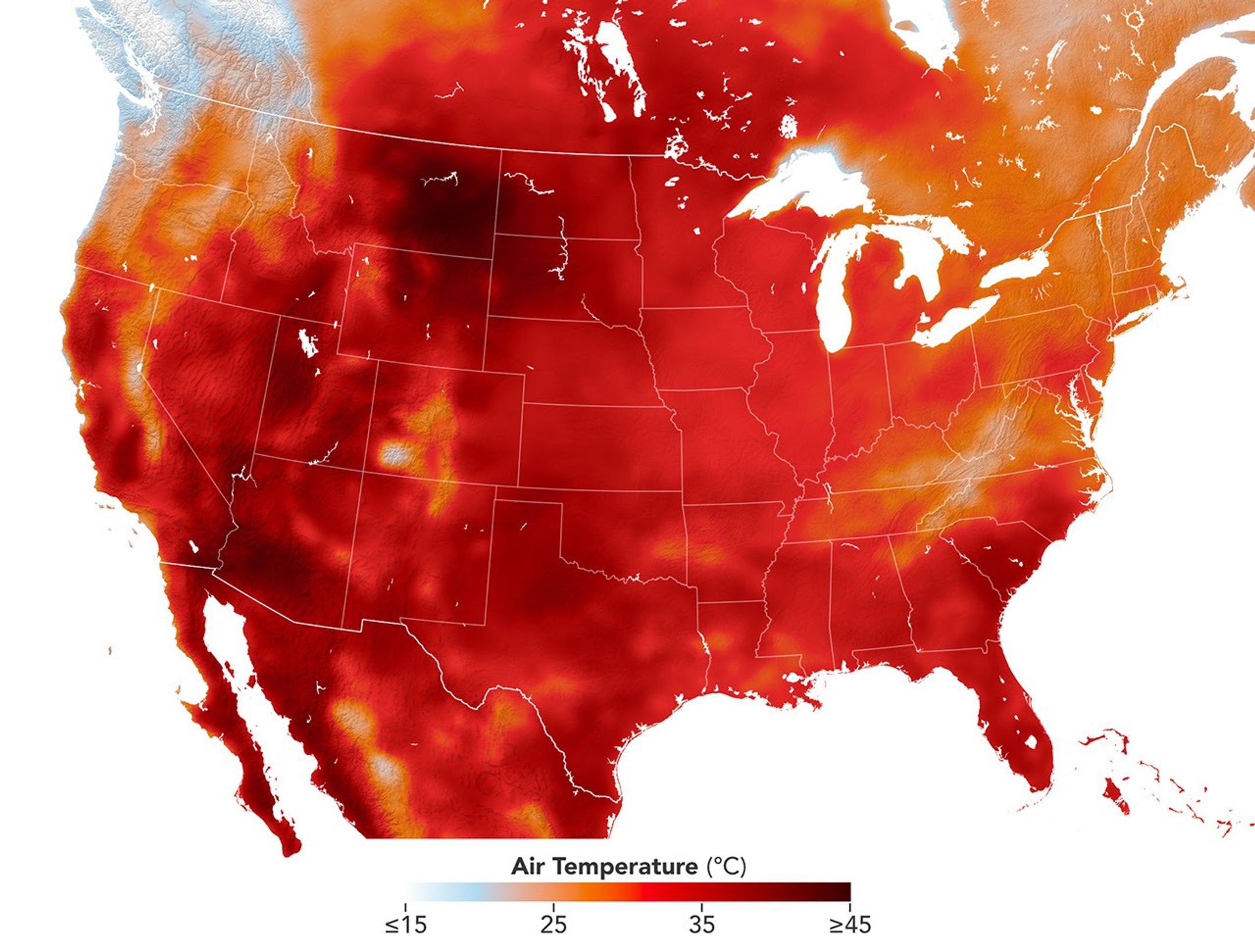
NASA Earth Observatory image by Michala Garrison, using GEOS-FP data from the Global Modeling and Assimilation Office and NASA GSFC. Story by Adam Voiland.


