







A September 2026 analysis by New York Fed researchers demonstrates how a handful of large reserve portfolios can reduce the global dollar share without a broad shift away from the greenback. For investors evaluating sovereign demand for Bitcoin, it is crucial to distinguish between a shifting average and a dedicated investment outlay.
Linda S. Goldberg, Oliver Hannaoui and Sneha Parthasarathi report that the dollar share of global official foreign‑exchange reserves fell from 64 % at year‑end 2015 to 56 % at year‑end 2025, using IMF COFER data.
Their country‑level evidence points to concentrated decisions and changes in reserve sizes.
Countries can adjust the currency mix of their portfolios (“preferences”) or alter the overall size of their reserves, thereby changing their weight in the global average.
When a country holding a below‑average dollar allocation builds up reserves, it can pull down the worldwide dollar share without reducing its own allocation. Switzerland illustrated this trend between 2015 and 2019: its reserve growth lowered the aggregate share even as its own dollar allocation rose.
For that decade, 76 nations with complete endpoint data saw preferences and reserve‑size components each decline by 1.2 and 1.5 percentage points, respectively.
For 2019‑2023, the 62 economies with full data contributed a net increase of 0.3 percentage point via preferences but a net decrease of 0.5 percentage point via reserve‑size shifts.
China, Russia, Mexico and Morocco lacked 2023 dollar‑allocation data. Matching the observed 2.3‑percentage‑point global drop, the researchers infer a combined negative 2.0‑percentage‑point preference contribution for this group.

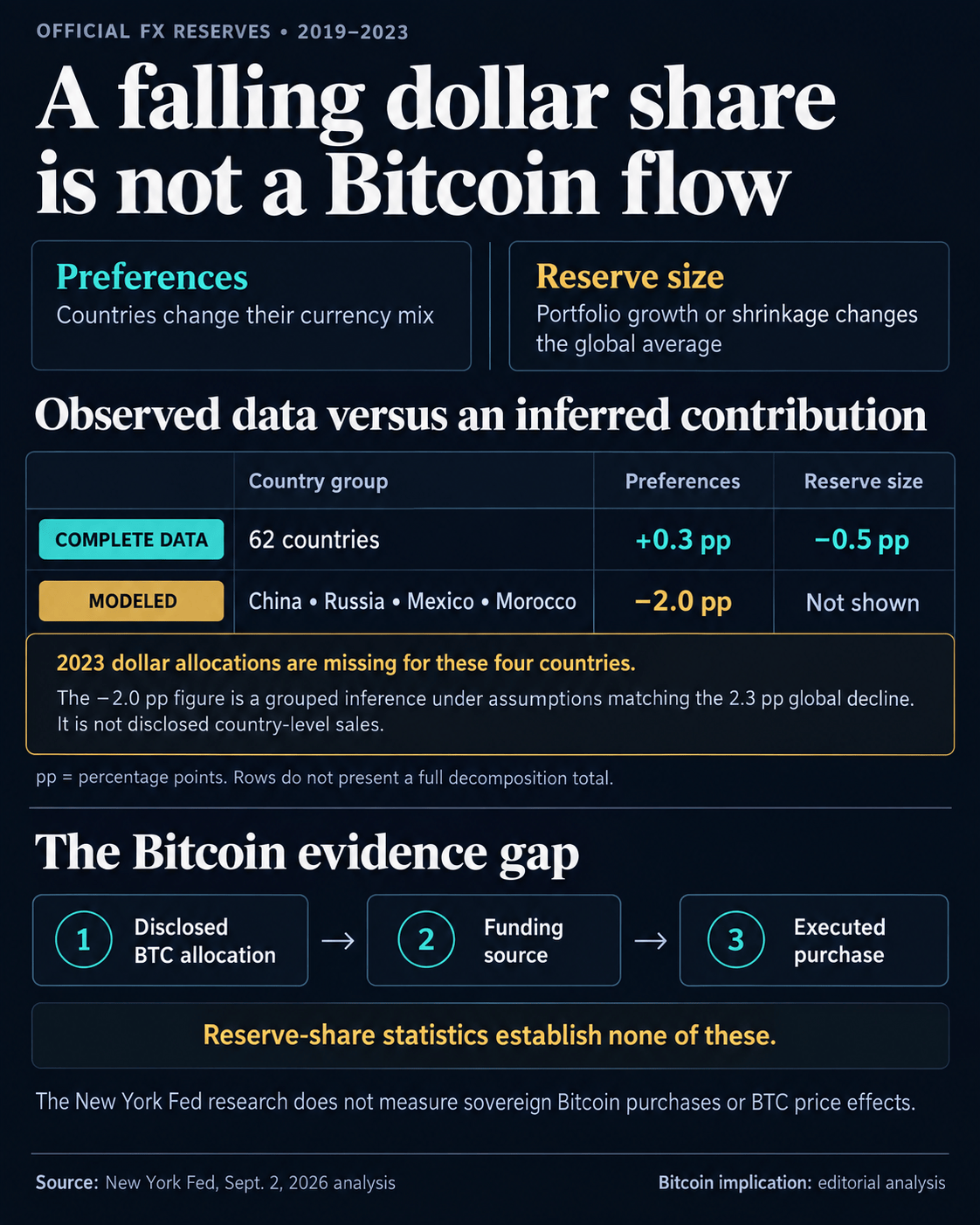
A Bitcoin allocation needs its own evidence
The underlying Staff Report 1087, issued in March 2024 and revised in February 2026, separates reserves needed for liquidity from an investment portion above those needs. Trade payments, foreign‑currency debt, and currency stabilization sustain the need for liquid reserves.
When a country can satisfy its liquidity requirements through diversified asset allocations, portfolio compositional shifts tend to correlate with changed reserve structures; those variations alone cannot reveal whether funds are directed to cryptocurrencies.
For the most recent period (2019‑2023), 62 economies with complete data delivered a modest boost of 0.3 percentage point through preferential reallocations offset by a slight contraction of 0.5 percentage point resulting from scale changes in the overall reserve stock.
Four major economies—China, Russia, Mexico and Morocco—did not submit 2023 dollar‑allocation figures. Assuming consistency with the observed global 2.3‑percentage‑point decline, the team attributes an estimated combined negative 2.0‑percentage‑point influence to these holders via preference effects.
Also Read
- Switzerland’s CHF Stablecoin Project Enters Pilot Testing With Nine Institutions
- US forces strike Iranian tankers linked to IRGC after warship attack claim
- Metaplanet Investors Seek to Reverse a 273 Million-Share Expansion of Executive Pay
- Gold Dips Toward $4,350 as Middle East Tensions Fuel Inflation Jitters Ahead of Key US Data


