



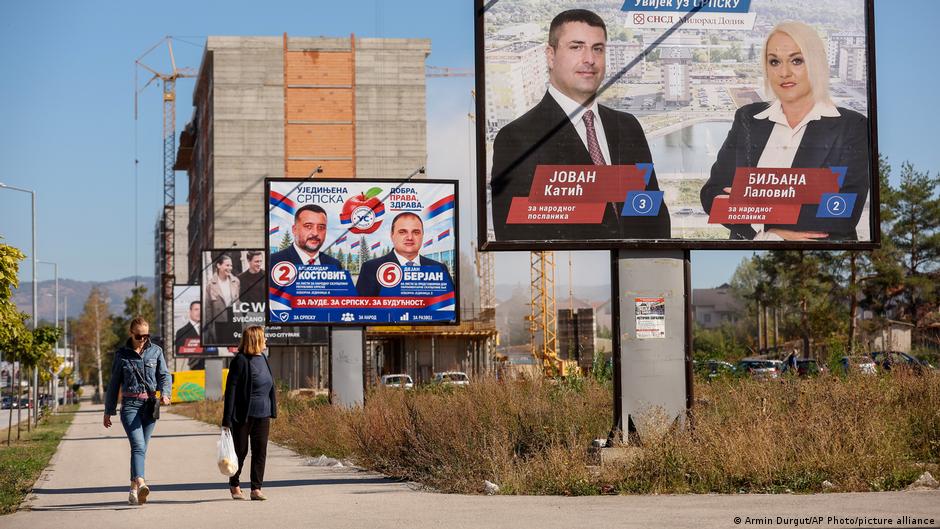
Bosnian officials announced that voter turnout hit a historic low, with just 41.5 % of the 3.4 million eligible citizens casting ballots in the recent election.
Polls closed on Sunday evening across Bosnia and Herzegovina, where approximately 3.4 million residents were eligible to vote in the general election.
With over 90 % of the votes counted, the Central Election Commission confirmed that turnout fell to a record low of 41.5 %, compared with 51.5 % in the 2022 election.
Nationalist parties swept the contests for various government levels, including the three‑person presidency that reflects the country’s ethnic power‑sharing arrangement.
As the vote count neared completion, Serb nationalist Zeljka Cvijanović, Bosniak‑leaning Denis Bećirović and Croat nationalist Darijana Filipović were declared victors in the presidential posts reserved for each ethnic group.
Cvijanović had the backing of Milorad Dodik, the former secessionist leader of Republika Srpska, who was barred from holding public office for six years after being convicted of defying the top international envoy overseeing the 1995 peace process.
“I am declaring that we have won,” Dodik told supporters in Banja Luka on Sunday night. He said his SNSD party had retained the Serb seat in the presidency and maintained its influence in Republika Srpska.
With the count almost finished, Cvijanović appeared to have secured 55.6 % of the vote.
Bosniak candidate Denis Bećirović captured 38.1 % of the vote for the Bosniak seat, whereas Croat nationalist Darijana Filipović received 48.2 %.
Nationalist and ethnic political division
Voters also elected members of the federal parliament and the leadership of the two largely autonomous entities — the Muslim‑Croat Federation of Bosnia and Herzegovina (FBiH) and the Serb‑run Republika Srpska (RS).
Currently, roughly half of Bosnia and Herzegovina’s population identifies as Muslim Bosniaks, 31 % as Orthodox Serbs and 15 % as Catholic Croats.
Between 1992 and 1995, over two million people were displaced and nearly 100,000 lost their lives in a civil war triggered by Serbia. Although the country has enjoyed peace in recent years, ethnonationalist parties continue to sustain divisions despite many voters’ desire to move beyond wartime rhetoric.
The election takes place amid several challenges facing the nation.
The country faces an economic downturn, slow progress toward EU membership, and persistent political gridlock, as dominant ethnic parties in the entities repeatedly block decisions made by the weak central government.
The election featured contests pitting the Bosniak SDA, Serb SNSD and Croat HDZ BiH against multi‑ethnic opposition blocs led by the Social Democratic Party.
Polls closed at 7 p.m. local time (1700 GMT), with preliminary results expected later that evening; however, the intricate constitutional framework and prolonged coalition negotiations may leave the final outcome uncertain for months.
What is the system that governs Bosnia-Herzegovina?
In Bosnia and Herzegovina, economic, administrative and political powers are shared among the multi‑ethnic central government, the two semi‑autonomous entities of FBiH and RS, and the self‑governing Brčko District.
Each entity is subdivided into numerous cantons and municipalities.
This ethnic‑based framework was established by the US‑brokered 1995 Dayton Peace Accords, which followed the 1992‑95 Bosnian war that erupted after Yugoslavia’s dissolution.
Milorad Dodik not on the ballot but still dominant in Republika Srpska
In Republika Srpska, secessionist leader Milorad Dodik of the SNSD remained a decisive influence in the election, even though he did not appear on the ballot.
Dodik, the former president of the Serb‑majority entity, is barred from holding public office for six years after being convicted of defying the top international envoy who oversees the 1995 peace process.
Dodik‑backed Savo Minic secured a decisive victory in the Republika Srpska presidency, and the entity’s share of the parliamentary vote rose to 39 %, up from 34.6 % in 2022.
Having just met Russian President Vladimir Putin in Moscow, Dodik seeks closer ties with Serbia and Russia and advocates secession from Bosnia and Herzegovina.
“Bosnia and Herzegovina is dead, it is an impossible country,” Dodik declared to supporters at his final rally in Banja Luka on Friday.
What is happening in the Federation of Bosnia and Herzegovina?
Within the Muslim‑Croat Federation, Bosniak parties are pushing for a stronger central government.
The leading Bosniak SDA party concentrates on preserving national unity in the face of Serb separatist pressures.
Bosnian Croats likewise largely support their ethnic parties, including the Bosnian branch of Croatia’s ruling conservative Croatian Democratic Union.
Meanwhile, incumbent Bosniak presidency member Denis Bećirović has pledged to renew the country’s drive toward EU and NATO membership.
EU ambitions
Bosnia and Herzegovina has held EU candidate status since 2022.
However, the launch of accession talks hinges on implementing a series of reforms, such as strengthening judicial oversight and enacting anti‑corruption legislation.
EU enlargement: Montenegro on track to join bloc by 2028
To view this video please enable JavaScript, and consider upgrading to a web browser that supports HTML5 video
Edited by: Natalie Muller
Also Read
- Nicaragua Announces Immediate Withdrawal from Central American Parliament
- Early Vote Count Places Flavio Bolsonaro Ahead of Lula in Brazil’s Tight Presidential Race
- Israel Mandates Comprehensive Security Audit of Incoming Flights After Co-Pilot Assault
- Cornell assault lawsuit exposes New York’s progressive reputation and dated rape laws