




Gold surged 3.7% to $4,495 on August 19, reaching its strongest level since early June, after an unexpected Treasury Department announcement triggered a sharp reversal in long-term yields and the U.S. dollar. The move puts a break above $4,600 within reach, opening a credible path toward the $5,000 level.
Treasury Buyback Announcement Triggers Long-End Yield Collapse
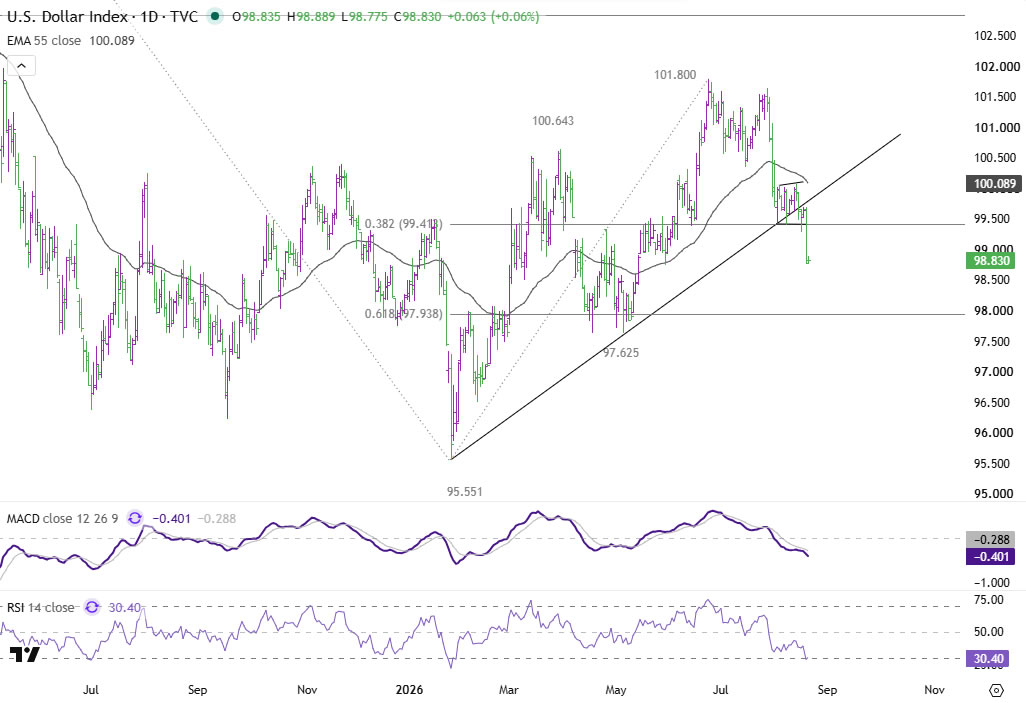
The catalyst was the Treasury’s decision to at least double the maximum size of its long-dated debt buybacks, increasing the cap from $2 billion to at least $4 billion. Operations targeting the 10–20 year and 20–30 year sectors are scheduled from September 9 through November 4. Although the enlarged purchases are weeks away, the bond market repriced immediately: the 30-year yield fell from a near two-decade high above 5.33% to approximately 5.20%, while the 10-year yield retreated from roughly 4.75% to 4.65%. The Dollar Index concurrently slid 0.8% to a fresh three-month low near 98.85.
This instantaneous reaction underscores how stretched the long end had become after persistent selling pressure. Markets effectively front-ran the anticipated liquidity support, driving yields lower before the Treasury purchased a single additional bond. Notably, gold advanced alongside equities and Bitcoin, signaling that falling real yields and a weaker dollar—rather than risk aversion—were the primary transmission mechanisms.
Hawkish FOMC Minutes Fail to Stall the Reversal
The durability of the move was tested by the release of the July FOMC minutes, which revealed a more hawkish tilt than the 9-3 vote suggested. Several participants favored an immediate rate hike, many saw further tightening as likely if inflation stalled, and some questioned whether financial conditions were sufficiently restrictive.
Gold’s ability to sustain gains despite this backdrop is significant. Bullion did not require a dovish Federal Reserve to break higher; the Treasury market supplied the necessary duration repricing. The yield decline was powerful enough to overwhelm a Fed message that, in isolation, should have supported yields and the dollar. It is worth noting that the minutes reflect a committee stance several weeks stale relative to this week’s developments.
A Real-Yield Driven Rally, Not a Debasement Trade
Breakeven inflation data clarify the underlying mechanism. The 10-year breakeven rate held steady around 2.30% on both August 18 and 19, even as nominal yields dropped sharply. With inflation expectations anchored, the decline in nominal yields translated directly into lower real yields—the textbook driver for gold appreciation.
This argues against interpreting the move through a currency-debasement lens. The Fed minutes signaled no accommodation, inflation expectations did not jump, and the identifiable catalyst was a Treasury-driven compression in long-duration yields. For now, the rally is best explained by a specific real-yield shock.
Dollar Breakdown Confirms the Gold Reversal
The dollar chart reinforces the same narrative. The DXY has broken decisively below 99.41, the 38.2% retracement of the 95.55–101.80 rebound, strengthening the case that the advance from 95.55 to 101.80 completed as a three-wave corrective move. Further decline is favored while the 55-day EMA near 100.08 caps recoveries, with 97.93—the 61.8% retracement—as the next downside objective.
Gold and the dollar are confirming each other from opposite directions: gold is breaking medium-term resistance just as the DXY fractures key near-term support. A move in the DXY through 97.93 would add further fuel to gold’s rally.
$4,600 Resistance Cluster Is the Gateway to $5,000
Gold’s technical structure has shifted materially. The larger decline from the 5,598.75 peak increasingly appears to have completed as a triangle pattern at 3,942.43. A daily MACD bullish divergence, a break above the 55-day EMA near 4,272, and this week’s clean break of a descending medium-term trend line all strengthen the reversal case.
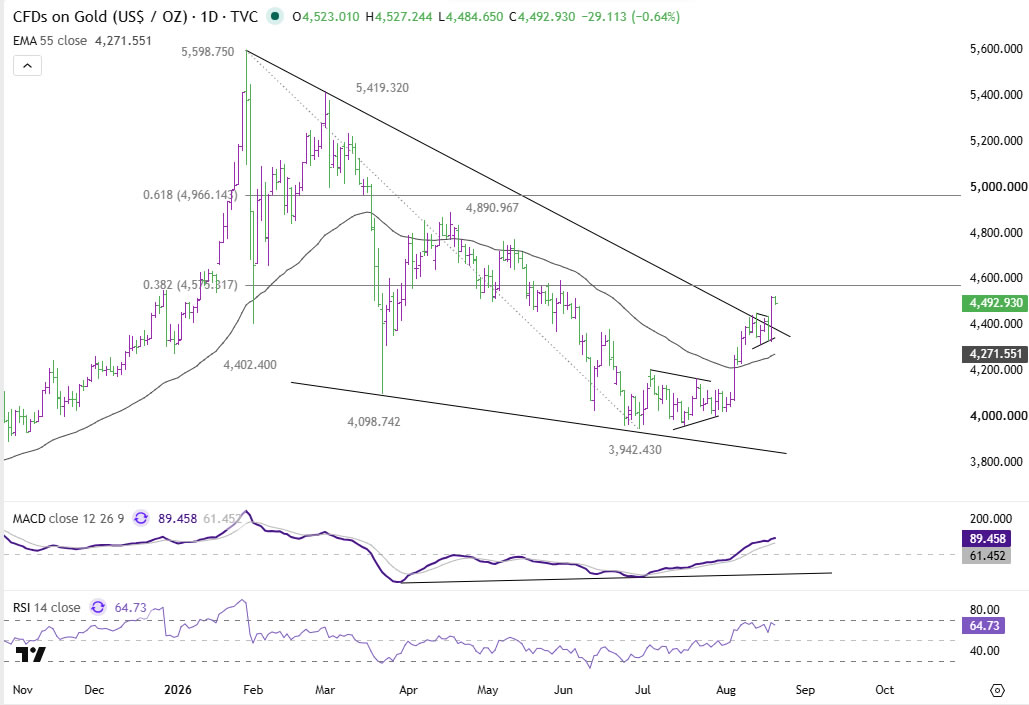
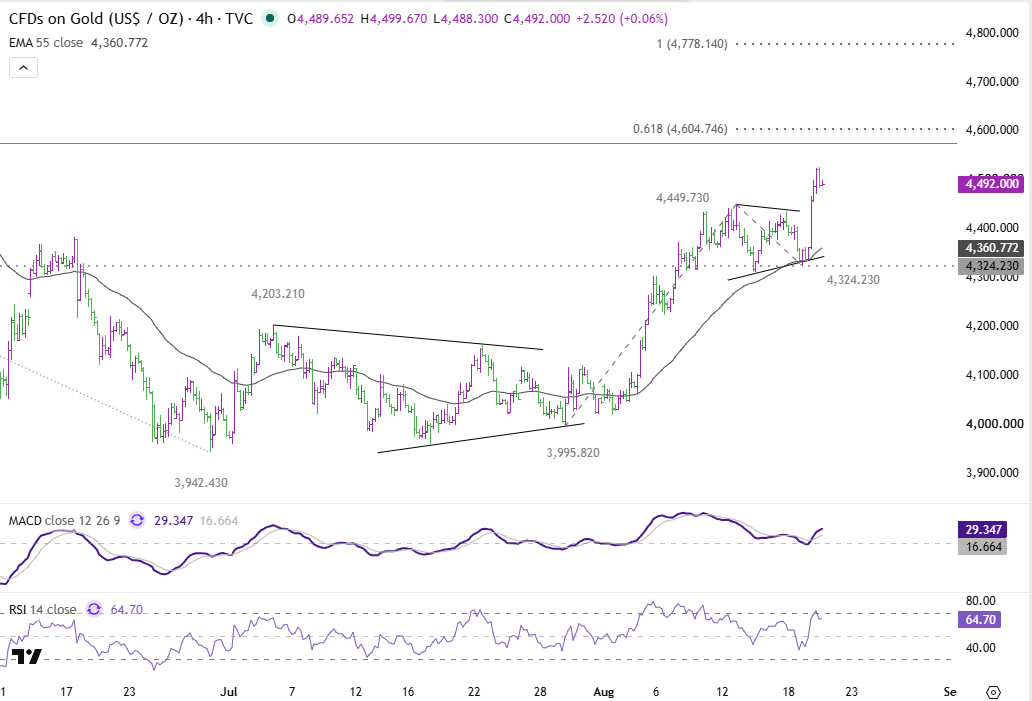
The near-term outlook remains bullish while support at 4,324.23 holds. The next decisive test is a resistance cluster between 4,575.31 (the 38.2% retracement of the 5,598.75–3,942.43 decline) and 4,604.74 (the 61.8% projection of the 3,995.82–4,449.73 advance from 4,324.23).
A clean break of the 4,575–4,605 zone would target the 161.8% projection at 4,778.14 first, followed by the 61.8% retracement at 4,966.14—effectively placing $5,000 directly into medium-term view.
Monitoring the Yield Curve: 30-Year Leads, 10-Year Confirms
Rates remain the key confirmation. The 30-year yield at 5.18% should be watched first, as the buyback impact is concentrated toward the long end and this maturity has led the recent reversal. A sustained break below 5.18% would indicate the duration repricing has further room to run.
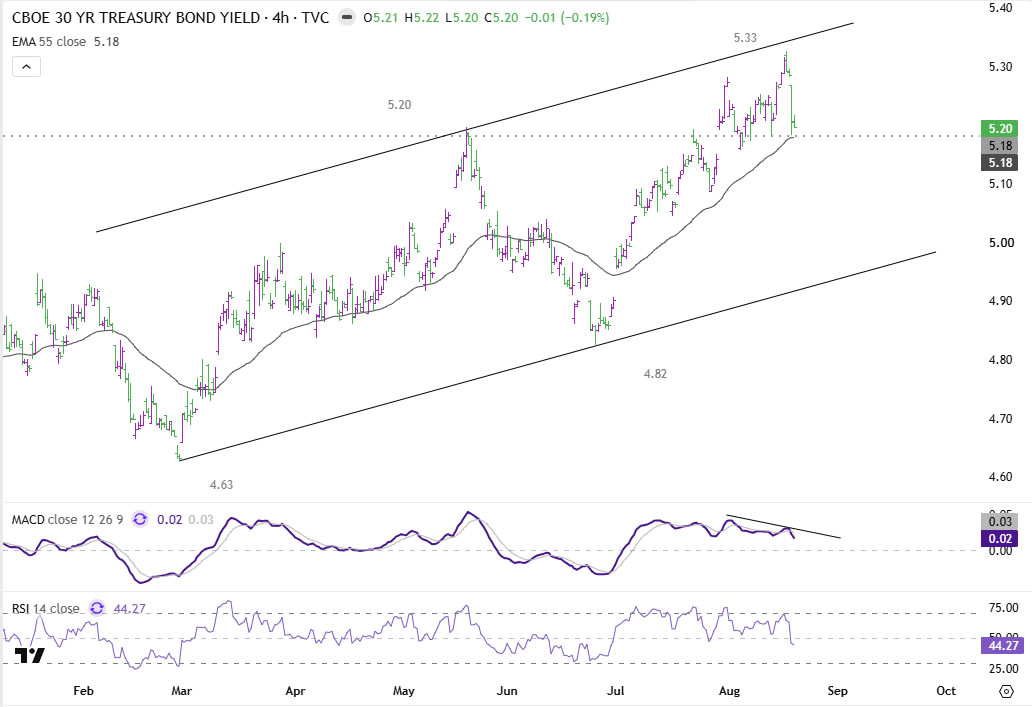
Support around 4.59% on the 10-year yield serves as the confirmation level. If the 30-year breaks lower while the 10-year holds 4.59%, the move remains concentrated in the long end—still gold-positive but less powerful for the dollar. A break of both would signal broader yield compression, strengthening the case for the DXY extending toward 97.93 while gold challenges the 4,600 level.
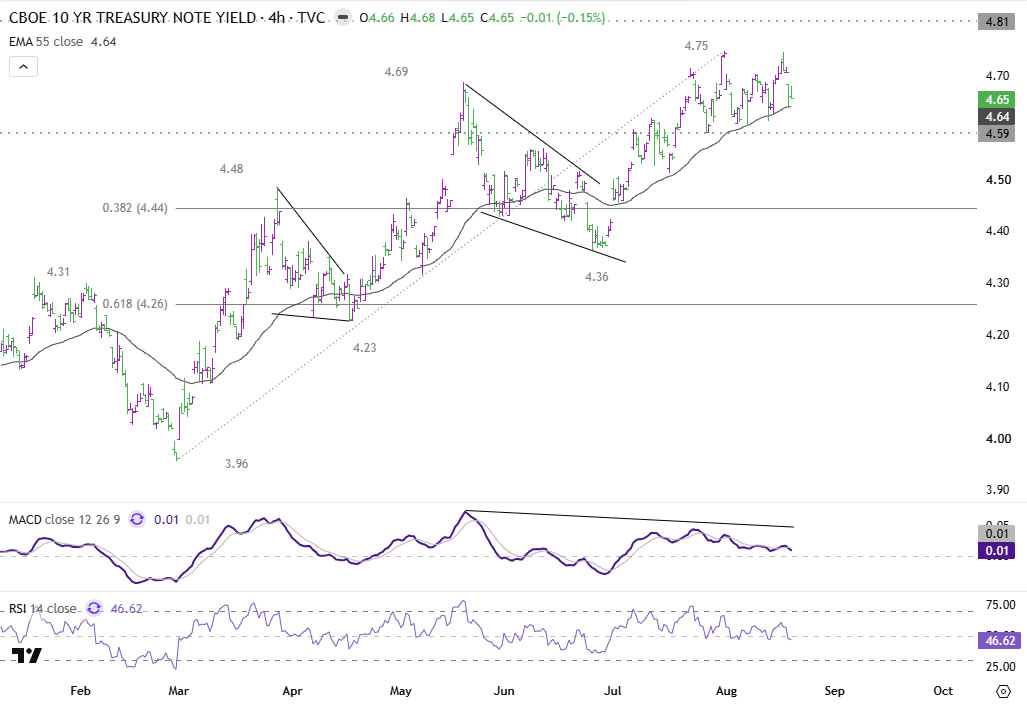
A final check is breakeven inflation. If nominal yields continue falling while inflation expectations stay flat or ease, real yields will compress further, preserving the cleanest bullish setup for gold. If breakevens rise sharply instead, the narrative would shift toward inflation repricing and become less straightforward. Track the T10YIE and T30YIE series alongside yield levels, not price in isolation.
For now, the signal is unusually coherent: long yields are breaking lower, the dollar is fracturing support, real yields are compressing, and gold has cleared its medium-term downtrend. The $5,000 level is not yet reached, but a decisive break above 4,600 would make it far more than a distant target.
Key Takeaways
- Gold surged 3.7% to $4,495 after the Treasury unexpectedly doubled its long-dated debt buyback authorization, triggering an immediate repricing in long-end yields.
- The rally withstood hawkish July FOMC minutes, confirming that duration repricing—not Fed dovishness—is driving the advance.
- Flat 10-year breakevens near 2.30% alongside falling nominal yields point to a real-yield mechanism, not a currency-debasement trade.
- The DXY has broken below 99.41 support, confirming gold’s reversal from the opposite direction and opening a path toward 97.93.
- A break above the 4,575–4,605 resistance cluster would target 4,778.14 and then 4,966.14, placing the $5,000 level within medium-term reach.
Also Read
- Bessent’s Market Intervention: Can the Former Hedge Fund Manager Stabilize U.S. Treasury Yields?</TITLE]Could a man who once assisted George Soros in breaking the Bank of England apply that same strategic playbook to defend the U.S. Treasury market?Since the beginning of this year, U.S. Treasury Secretary Scott Bessent has executed a series of unexpected market maneuvers aimed at suppressing U.S. borrowing costs. According to Bloomberg, he has become “the most interventionist Treasury secretary in decades.”Following the coordinated U.S.-Japan intervention in the yen, Bessent’s latest strategy involves expanding Treasury buybacks. The Treasury Department announced it would “at least double” the scale of buybacks for 10- to 30-year Treasury bonds—a plan that had only been introduced two weeks prior. Following the announcement, the 10-year Treasury yield fell by approximately 6 basis points, the 30-year yield dropped nearly 9 basis points, and the dollar index reached a three-month low.The market’s reaction appeared to validate Bessent’s strategy. He has publicly asserted, “My job is to be the country’s top bond salesman, and Treasury yields are the barometer of success.”From Sterling Speculator to Bond Market GuardianTo understand Bessent’s current strategy, one must look back to 1992.That year, a young Bessent was working at Soros Fund Management, contributing to the short position against the British pound. On “Black Wednesday,” the pound was forced out of the European Exchange Rate Mechanism, resulting in a profit of over $1 billion for Soros. Media reports from the time described Bessent as an individual capable of “seeing market vulnerabilities others couldn’t.”He later returned to Soros as Chief Investment Officer, leading a $1 billion short position against the yen in 2013. In 2015, he founded Key Square Capital Management with $4.5 billion, successfully navigating bets on both Brexit and the 2016 U.S. election results.This predatory logic—identifying and exploiting market cracks—has defined his hedge fund career. Now, he is applying those same instincts to the opposite objective: defending a market under significant pressure.The 2024 Intervention Strategy: From Yen to TreasuriesBessent’s actions this year reflect a coordinated logic.First, the yen intervention: On July 31, the U.S. Treasury joined Japanese authorities in purchasing yen, marking the first direct U.S. intervention in the yen exchange rate in nearly thirty years. Data from the Peterson Institute for International Economics (PIIE) shows that Japan utilized roughly $87 billion in foreign exchange reserves to support the yen during the final days of July, with the U.S. Treasury providing crucial political signaling. Notably, the Treasury opted to sell euros rather than dollars and did so without prior notification to Eurozone authorities.A strategic link exists here: Japan is the largest overseas holder of U.S. Treasuries, with holdings of approximately $1.1 trillion. If Japan had been forced to finance the intervention alone, it might have needed to sell Treasuries, which would have driven up long-end yields. Washington’s involvement allowed Japan to avoid such sales, indirectly stabilizing the yield curve.Second, signals of reduced issuance: Earlier this month, the Treasury suggested a potential reduction in long-term bond issuance, signaling a tightening of supply to the market.Third, expanded buybacks: This week, the department announced it would at least double its scale of long-dated Treasury buybacks, providing direct demand-side support for bond prices.Bloomberg noted that Brad Golding, a portfolio manager at Christofferson Robb & Co., views this as an “old-school ‘clearing the screen’ move”—a hedge fund technique used to trigger market moves by placing large orders with multiple dealers simultaneously.Mark Sobel, a former U.S. Treasury official currently at OMFIF, told Bloomberg, “He’s definitely an activist—it’s reminiscent of his hedge fund background. He and this administration are clearly concerned about rising long-end yields.”Departing from TraditionBessent’s strategy represents a departure from long-standing Treasury tradition.The U.S. Treasury has traditionally operated on the principle of “regular and predictable” debt management to avoid market surprises. While Bessent himself endorsed this principle last November, his recent actions have moved away from that commitment.Gregory Faranello, head of U.S. rates trading and strategy at AmeriVet Securities, told Bloomberg, “This goes against the ‘egular and predictable’ principle—but this is the world we live in. The signal is clear: stop yields from rising.”The situation contains a layer of irony: Bessent’s predecessor, Janet Yellen, also adjusted debt issuance structures to manage yields in 2023—a tactic Bessent had criticized as politically motivated. Furthermore, Stephen Miran and Nouriel Roubini co-authored a 2024 paper criticizing “Activist Treasury Issuance” (ATI), warning that if one administration begins using ATI for economic stimulation, future administrations will likely follow.Can Intervention Resolve Structural Issues?While markets have reacted to Bessent’s moves, many economists remain skeptical regarding the long-term efficacy of these interventions.In the first ten months of fiscal 2026, net federal interest payments reached $963 billion—approximately $3.18 billion per day, a 14% increase year-over-year. With the 10-year Treasury yield at 4.72% and the 30-year at 5.31%, the government is rolling over significant volumes of low-interest debt into much higher-rate environments. The fiscal 2026 deficit currently stands at $1.8 trillion, up 5% from last year, driven by rising costs in Social Security, Medicare, defense, and debt interest.Robin Brooks, a senior fellow at the Brookings Institution, told Bloomberg, “This isn’t solving the fundamental problem—cutting debt and reducing the fiscal deficit—it’s trying to manipulate the yield curve.”John Velis, a macro strategist at BNY, added that easing long-end pressure will be difficult given current spending and geopolitical conflicts.The effectiveness of the yen intervention remains debated. While USD/JPY fell from a peak of 163.98 on July 23 to 159.43 by August 17, CNBC reports that the intervention failed to halt the yen’s overall weakness. Maurice Obstfeld of the PIIE noted that such interventions are not a “free lunch.”Guy Miller, chief strategist at Zurich Insurance, told Bloomberg, “This approach only works for so long. While persistent intervention can have a strong effect, it is ultimately unsustainable without addressing profligate fiscal policy.”Peter Boockvar, chief investment officer at Onepoint Bfg, was more blunt: “He’s fighting two giant markets at once—Treasuries and FX—and that’s an extremely difficult battle.”A Bet on Market SignalsBessent’s underlying logic is evident in his own commentary. Discussing administration holdings last month, he stated, “What we’re trying to do is create market signals,” adding that the goal is to tell investors, “OK, where’s the puck going—skate there quickly.”The challenge is that while his 1992 strategy involved striking a single, decisive blow against a specific institutional weakness, he now faces systemic pressures—fiscal deficits, inflation expectations, and Fed policy—that cannot be resolved through buybacks or currency intervention alone.According to Bloomberg, Mark Sobel, a veteran of the Treasury for nearly 40 years, views Bessent as the most aggressive secretary since the early 2000s, while suggesting that the yen intervention may be unwise as it sidesteps the necessary fiscal consolidation required by the United States.
- Bitcoin treasury Hyperscale sells 686 BTC to clear loans but says cash won’t cover next 12 months
- Australia Employment Slumps 15.8K, Unemployment Rises to 4.5%, Offering RBA Further Signs of Economic Cooling
- Bitcoin Surges 8.7% in Best Day Since March, Flipping Prediction Markets to a Toss-Up