



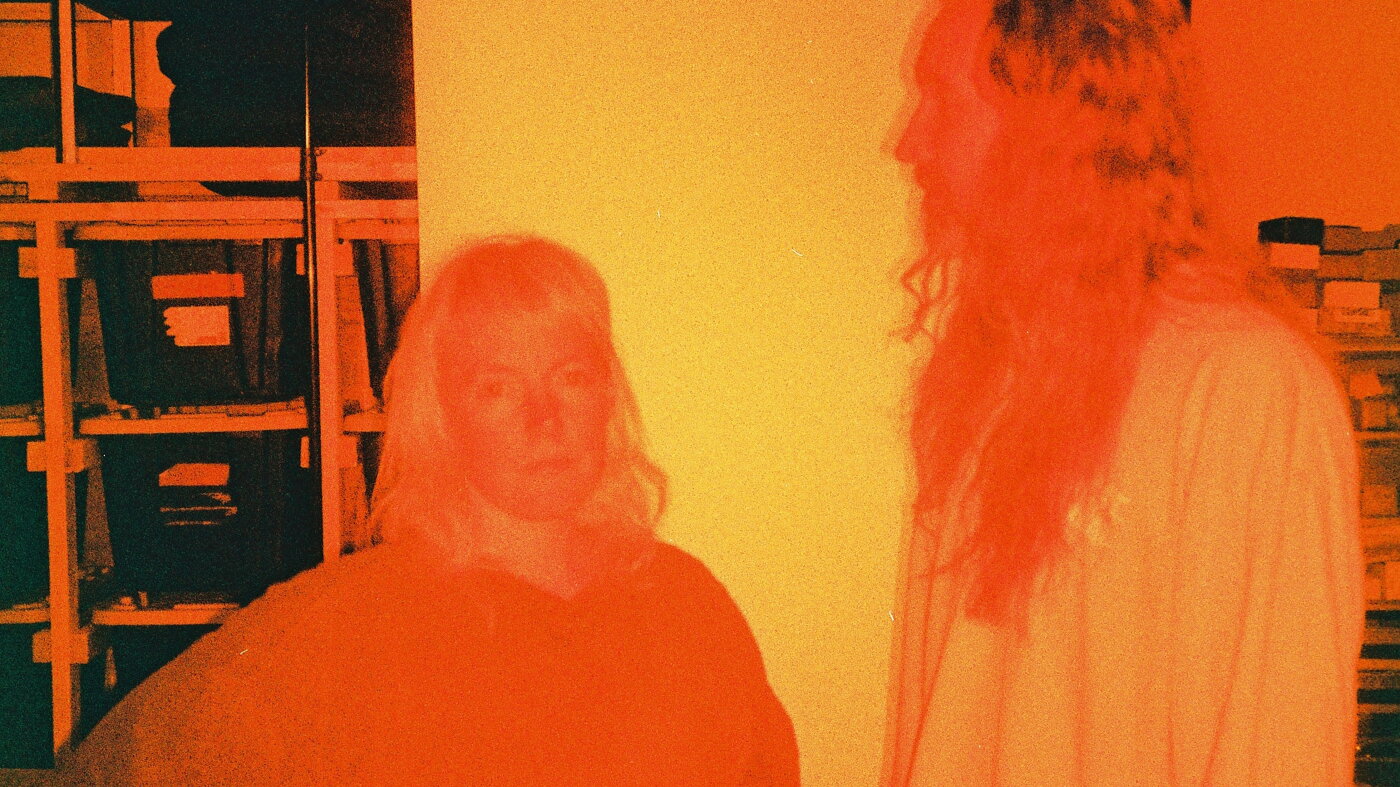
A year after pulling its catalog in protest, the duo is back on the platform. For Amelia Meath and Nick Sanborn, the journey has been frustrating, eye-opening, and marked by smaller victories.
Sylvan Esso’s fifth studio album, Ow ∞ (“ow infinity”), was released Sept. 11 on the band’s own label, Psychic Hotline.
Graham Tolbert/Psychic Hotline
hide caption
toggle caption
Graham Tolbert/Psychic Hotline
In September 2023, the electro-pop duo Sylvan Esso made headlines by announcing the removal of its catalog from Spotify. The world’s largest music streamer was no stranger to criticism, having faced years of scrutiny over its payment structure and high-profile boycotts — most notably from Neil Young, who in 2022 accused the service of platforming misinformation. The stakes shifted dramatically in 2023 with the revelation that Spotify’s then-CEO, Daniel Ek, was a major investor in Helsing, an AI software company developing military weapons systems.
Beginning that June with the experimental rock group Deerhoof, a wave of prominent independent artists pulled their music, denouncing the use of their work to fund defense technology. Sylvan Esso — married couple Amelia Meath and Nick Sanborn — became arguably the most visible participant in that cohort: an established act for over a decade, darlings of public radio and late-night television, a likable and media-friendly pair whose Grammy-nominated work balanced accessibility with unconventionality.

A year later, the band has returned with new music and another significant announcement. Ow ∞ (pronounced “ow infinity”) is Sylvan Esso’s fifth studio album, released on its own label, Psychic Hotline, and created with a large cast of collaborators at Betty’s, Meath and Sanborn’s homegrown recording studio in North Carolina’s Triangle region. The album arrived on Sept. 11. A week later, an Instagram post announced that Ow ∞, along with the rest of the band’s discography, would return to Spotify beginning Sept. 18.
In a conversation with reporter Brian Burns from NPR member station WUNC in Chapel Hill, both Meath and Sanborn describe that return as the result of sobering discoveries during their year away from the platform — but also emphasize how much they learned in the process. Below is a portion of that conversation; for the complete interview, listen at the audio link or in the NPR Music podcast feed.
This interview has been edited for length and clarity.
Brian Burns, WUNC: About a year ago, you announced you were removing your catalog from Spotify, citing Daniel Ek’s ties to the weapons manufacturer Helsing as the final straw. Now you’re back. Talk to me about the decision to return.
Amelia Meath: First, I want to say it was a fascinating exercise to simply do the thing we thought was morally correct. In music, you often do a lot of looking away.
Nick Sanborn: And in life, I think.
Meath: And in life. I’m really proud of the decision to get off Spotify — but it ended up feeling truly unsustainable. Namely, it turns out monopolies are bad. It touched every aspect of our career.
Sanborn: It became clear that, for us at least, we aren’t big enough to escape the reality of the capitalist system. It felt like the right thing at the time, and I’m proud we lasted as long as we did. I underestimated how much of our career it affects. It was kind of depressing, honestly.
Burns: What does that look like from your end as artists preparing a new album and launching it? How important is Spotify? How involved are they?
Meath: The thing that pushed me over the edge: we’re putting out our own record on our own label. I just want everyone to hear it. By taking ourselves off Spotify, we accidentally created a significant barrier to access. I didn’t expect this because if I want to hear a record, I’ll go find it online. But a lot of people go to their streaming service, see it’s not there, and listen to something else.
Sanborn: It hits literally everything. It’s not just the financial hit — which was substantial. I joke that we’re the last middle-class band in the world. It was a significant loss I was honored to take. But beyond that, it puts a blanket over everything you do. Unless we want to stop this career or radically change how our job functions, this is the only way to do it for now.
Burns: With that in mind, do you think an artist can thrive today without their catalog on Spotify?
Meath: I think it’s totally possible. We’d be fine. It’s not ending the band. The issue is I want people to hear our record, and it creates a significant barrier — especially because we’re doing it ourselves. If others were pushing it, that’d be different. But selling our own product, I don’t want to create more barriers.
YouTube
Burns: Do you remember the first moment you realized not being on Spotify would be trickier than imagined?
Meath: It’s been like that since the moment we did it. A year ago. It’s been really obvious.
Sanborn: I’ve been wrestling with protest in general — something common in this age where everything feels awful. You go to a protest or commit an act of protest, then go home. Sometimes that feels fine — like you pushed something forward. Sometimes you get home and wonder, “Did I do anything at all?” Besides participating in a narrative people see themselves in.
When we realized staying off was unsustainable, part of me felt like: did I do anything? The cynical part says no. But I talk to people daily for whom it was a wake-up call — they got off Spotify too. I’m grateful for that reflection in people who pay attention to us. So many other things I’ve tried in the political world felt like nothing happened.
Burns: What makes a protest successful?
Meath: We were just talking about this on the drive over. I don’t know. Particularly now, with two generations above us who spent time talking about protest’s importance and congratulating themselves on successes that have slowly revealed themselves not to be successes in the ways we were told. But I know it felt good to do something I believe in. And I know it helped — the feedback from people saying, “When you did that, it made me feel like I could too.”
Sanborn: I think we all feel the bad guys will win and there’s nothing we can do. But they just want you to believe that. You can do so many things that ruin their plans. When something isn’t perfect, it gets weaponized against the idea of any action. I don’t want that to be my experience of resistance anymore.
Meath: Me neither.
Sanborn: Because it’s self-defeating. If a single person told me this changed their mind, that might feel like enough.
Burns: The catalog returned Sept. 18, the album came out Sept. 11. Was that intentional? Were you trying to learn something in that week?
Sanborn: It’s the one-year anniversary of taking it down. My pride wanted to make it a year.
Meath: We asked our team to release the record without Spotify, and we wanted to deliver on that. It felt really good and interesting not to participate in the Spotify machine, which can become the whole story of your rollout.
Sanborn: We didn’t want coming back to be the story of the record. We just wanted people to hear it and like it for what it was, or not.
Burns: A year ago you weren’t the only major artist to do this — King Gizzard and the Lizard Wizard, Godspeed You! Black Emperor, Deerhoof.
Sanborn: Massive Attack.
Burns: Massive Attack, of course. Were there conversations between you and these other artists?
Sanborn: Unfortunately, no. I wish there were. We have friends in the King Gizz camp, so I hoped for more coordination. But King Gizz — that’s the dream. Their career truly has nothing to do with Spotify.
Meath: They’ve never really had Spotify listenership in the same way. They’ve always been a Bandcamp band.
Sanborn: That’s what I mean. They’re a massive band who could take this stand, and I’m proud to be mentioned alongside them.

Burns: Let’s talk more about the return decision. Was it just between you two? Do you involve your team?
Sanborn: Ultimately it’s just us. We ask the team for input to feel out how everyone feels — sometimes you ask someone how they feel to figure out how you actually feel. They’re all smart and I love their viewpoints. But once we decided, they were great at saying, “OK, how do we do this? How can we help?” We’ve asked a lot of them and they’ve been wonderful.
Burns: As partners in life and music, was there ever a point you weren’t on the same page?
Sanborn: Yeah. Everything with our band is a discussion between us, and we disagree all the time.
Meath: Taking the music down was my idea initially, and it was easy. Nick said “Absolutely.” Then as we got deeper, I said, “We should put it back.” That was the more complicated decision.
Burns: From your perspective, has Spotify changed at all in the last year?
Meath: No, not at all. Not in any way.
Sanborn: They made a hullabaloo about some changes that I think were nothing.
Meath: It hasn’t changed. It’s not going to change.
Burns: What advice for other artists considering leaving, or newcomers wondering if they need to be there?
Meath: If you like doing anything other than making music, do that. [Laughter] If you can be happy in your life, do something else.
Sanborn: Our action wasn’t about convincing other artists to do this. The bar is extremely high.
Meath: It’s not fair to ask anyone to do.
Sanborn: The penalties are massive — financial, logistical, conceptual. They touch everything. We were in a lucky position where all three aligned for a moment: we could pull it off for a while. But that’s not a luxury most artists have.
What people can do easily is stop giving Spotify money if they’re subscribers. Switch streaming services in five minutes. Everyone wants to do that for you; it takes almost no effort. This always gets framed as “What should other artists do?” and I’m like — I don’t think artists should have to make this extremely difficult decision.
Meath: There are only so many ways to make money in this industry.
Burns: I hear about new bands relying on Spotify because that’s how touring gets booked. Is that something you experienced? Anything else the average person might not know?
Meath: Spotify touches every aspect.
Sanborn: It’s a ubiquity thing.
Meath: Physical sales, ticket sales.
Burns: Can you imagine an ethically and economically viable streaming service? Is that possible?
Meath: Absolutely. That would be cool. I just don’t want my life’s work on a platform supporting robots that can kill people. [Editor’s note: NPR reached out to Spotify for comment on Daniel Ek’s ties to Helsing. A representative declined to comment.]
Sanborn: Neither of us has a problem with streaming in general. I buy records and have multiple streaming subscriptions. A sustainable business model for everyone is absolutely possible. But when one platform is a monopoly, that’s bad for everyone — bands, consumers, everything. There’s a reason we have laws against this. If that got evened out? Yahtzee. Maybe we find a better path. They keep telling us about the magic of the free market — I’d love to experience some of that magic.
YouTube
Burns: If someone asks the best way to support you or other musicians financially and ethically, what do you say?
Meath: Like any product, the best way is to buy it. People ask, “How do I support you?” Well, just buy the thing I’m selling. You don’t even need to listen to it. Everyone can answer that for themselves. There’s a chosen… what’s the word for when you’re an accidental baby? Learned…
Sanborn: Learned incompetence.
Meath: Learned incompetence, yeah. Streaming has accidentally created a learned incompetence.
Sanborn: Which speaks to the monopoly.
Meath: Yeah. “How do I do this?” You know how. Buy a t-shirt.
Sanborn: A bigger one I’d highlight: buy a ticket to a show in advance. That’s huge and game-changing for a band you like. Nobody’s selling tickets anymore; that’s a massive shift in five years. If you see they’re coming to your town, buy a ticket before the show.
Bands set budgets based on presales. They decide if a tour happens based on presales. Presales have plummeted even if day-of-show numbers are up. That’s huge for bands selling less than 500 tickets a night.
Meath: It also boosts confidence. People need that — it’s scary to decide to tour.
Burns: It seems so expensive now, on top of everything.
Meath: It’s really expensive. It just lets you know there’s money on the table.
Burns: Final question on Spotify: any concerns about public reaction when you announced the return?
Sanborn: Of course.
Meath: Of course. Trying to address anything gives people permission to get angry when you make a different decision. But one of the most human, real, honest things you can do now is say you changed your mind and own it.
Sanborn: Or that the act doesn’t have to be perfect to be impactful. I hope someone takes that into their life — this doesn’t need to be a pristine diamond of protest. Just do what you can and say what you think.
Also Read
- Stranger Things: Tales from ’85 Season 2 Channels Stephen King’s Signature Fear
- For Rhiannon Giddens, the Banjo Is a Bridge to Her Ancestors
- Taylor Sheridan Redefines Television with Uncompromising Storytelling
- Modern English Says The Strokes “Completely Ripped Off” “I Melt With You”—Though the Band Still Loves Them