






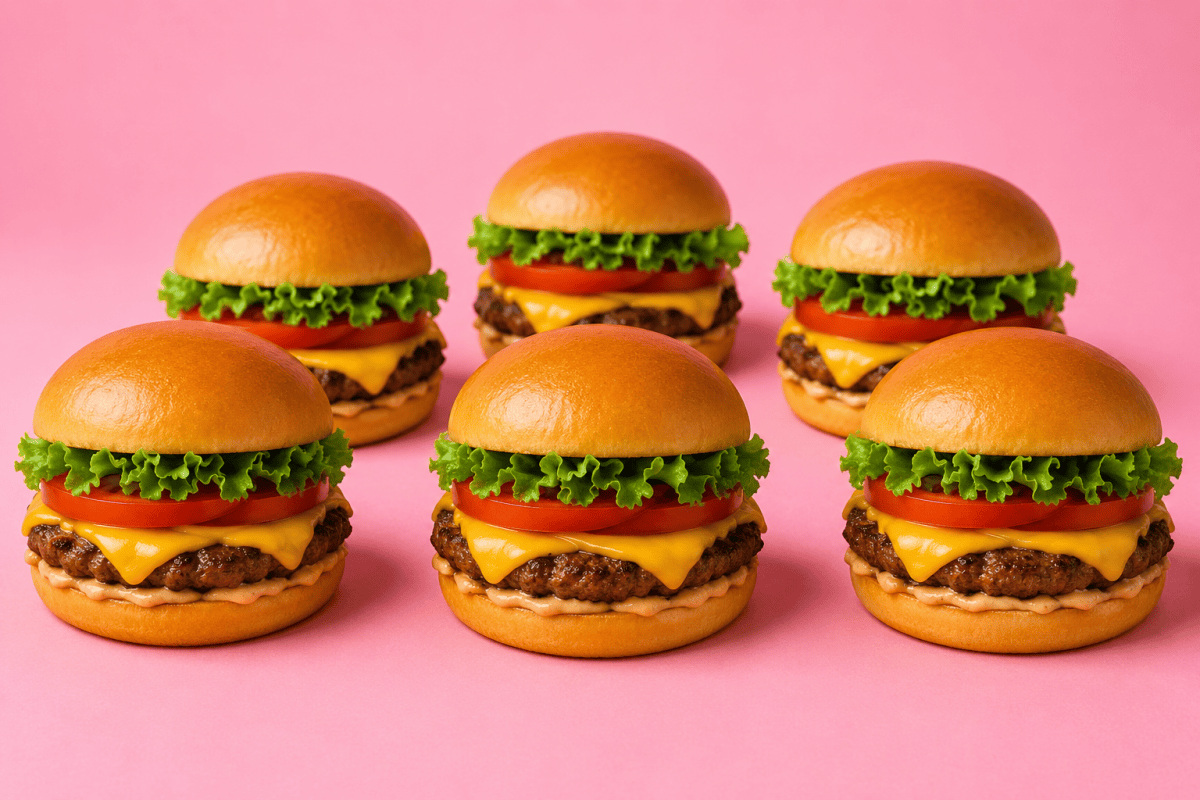
When it first appears to you, you wonder if you are imagining things. Walking into a café and examining a menu filled with bagel sandwiches, each illustration strikingly flawless, perfect in symmetry and eerily smooth, generates a strong intuition that something is substantively off. Though initially mistaken for pure paranoia, you are simply not losing your mind. Generative AI menus have infiltrated the restaurant industry thanks to models predicated on constrained, ‘pleasantly optimized’ aesthetics that produce visuals indistinguishable yet disturbingly incongruent because the quality cannot be articulated directly.
Frequently, these depictions are alarmingly unrealistic—consider a burrito with cheese so foamy and molten it mirrors avant‑garde painting rather than nourishment. More commonly, the graphics appear ordinarily realistic until a closer scrutiny reveals minute inconsistencies.
“It reminds one of an extraterrestrial attempting to bake a pizza without mastering its fundamental laws,” said Alex Lisle, CTO at Reality Defender, a firm building AI detection and verification platforms within an expanding ecosystem born from challenges like this one. (Reality Defender competes within a larger market supplying tools designed to identify deep‑fakes and verify authentic content.)
Lisle observes that the underlying architecture illuminates why images adopt such a persistent stylized pattern—each scoop of ice cream arrives uniformly perfect, while seafood appears engineered to bite its own tail, creating grotesque ‘Lovecraftian’ culinary nightmares.
Language models (LLMs) and diffusion systems—the technologies powering ubiquitous conversational agents and image synthesizers like ChatGPT and Midjourney—operate by ingesting massive corpora before discerning patterns to anticipate user intent such as requesting a menu for a specific eatery.
“Requesting a burger establishment menu yields outcomes that echo familiar chains like Wendy’s, Burger King, or McDonald’s, whose official presentations already share coherent design languages; consequently, synthetic outputs mirror and amplify these preexisting motifs, reinforcing them whenever generated menus circulate back into training pipelines.”
According to Lisle, the systemic logic governing these constructs clarifies why food visuals develop identical characteristics—a convergence that elevates uniformity above novelty.
Present LLMs and diffusion architectures emerge from extensive datasets of linguistic and visual material. After generating replies or artwork pursuant to prompts, those creations guide future interactions: such guidance stabilizes performance during appropriate conditions but risks deterioration under recursive exposure.
“Large data reservoirs constitute essential assets for AI developers who occasionally source rare publications solely to augment learning populations, later discarding physical copies once scanning concludes. When synthetic artifacts permeate these overwhelmingly voluminous corpora, the resulting homogenization threatens long-term reliability.”
“Model instability resembles a pathological condition developed through relentless inbreeding,” Lisle analogized, explaining that “feeding model outputs back onto themselves accelerates deterioration until functional integrity disappears.” Here he distinguishes full‑scale collapse from simpler **convergence**, which degrades performance without rendering the system wholly useless.
“Convergence entails progressive erosion of output fidelity while retaining basic comprehension capability.”
If an inquiry targets a fast‑food venue, the algorithm typically references established corporate templates such as those employed by international franchises. Given the inherent stylistic overlap among mainstream brand representations, synthetic recipes inevitably emulate—and then perpetuate—that shared template when the resultant artifact reappears within the training pipeline.
Yet food signage and advertising invariably appear more compelling than their physical counterparts; a Big Mac promoted in commercials gains allure from deliberate compositional precision mimicking artisanal craftsmanship. Artificial renderings intensify this illusion further.
“Prioritizing aesthetic polish—or neutralizing potential offense—induces a process of boundary reduction,” observed Lee Rainie, Director of the Imagining the Digital Future Center at Elon University, quoting TechCrunch. “Such capabilities tend to flatten distinctiveness in both visual and verbal domains.”
On a regional level, iterative software interventions reveal systematic drift in rendered meals. A user on X crafted a menu via an AI interface and subsequently edited it one hundred times, observing progressive degradation of realism. Replication of this experiment produced parallel findings.
“The final product provokes genuine unease,” Labtec posted on the platform, documenting her series of incremental modifications and noting the steady loss of recognizable texture.
I constructed a restaurant menu using ChatGPT and then refined each element a hundred times to watch how those grotesque, distorted menus solidify. The outcome leaves me genuinely uneasy @t.co/sDIUKlabdp
— Labtec (@labtec901) August 19, 2026
Establishments appear vulnerable to this paradoxical dynamic, continually adjusting synthetically‑generated specifications—pricing, nomenclature, presentation—over successive revisions. With each iteration, menu visuals accumulate ever‑more rounded, polished surfaces.
“Consumers possess an introspective sense that distinguishes AI‑originated material from tangible reality, an instinct often difficult to formalize yet universally recognized. This gut response likely contributes to earlier criticism levied against early AI‑menu rollouts, making retrospective commentary especially resonant.”
Research supports this aversion. Scholars at Germany’s University of Duisburg‑Essen identified an “uncanny valley” effect wherein near‑realistic food imagery elicit heightened disgust and anxiety surpassing those displayed blatantly fake. This squeamishness compounds given current societal narratives surrounding artificial consciousness.
Should audiences respond with considerable negative energy, establishments would logically abandon synthetic menu initiatives altogether. Still, complications extending beyond dining tables underpin deeper concerns about public perception and information ecosystem integrity.
“Visual immersion mirrors factual acceptance—even courts treat recorded testimonies as irrefutable proof. That paradigm has evolved beyond previous orthodoxy.” Lisle concluded that humanity now perceives sight and sound alike as definitive evidence.
Disclosures regarding affiliate partnerships from linked commerce mean modest commissions are earned; such arrangements do not compromise editorial impartiality.
Also Read
- Stem Cell Advances Bring Lab-Grown Steaks a Bite Closer
- Audacity 4.0 Arrives with Major UI Overhaul and Advanced Non-Destructive Editing Tools
- Body parts used for ancient Egyptian artworks traced to surprising source
- IFA Berlin 2026: Live Coverage of the Biggest Tech Reveals From Samsung, LG, and Other Industry Leaders


